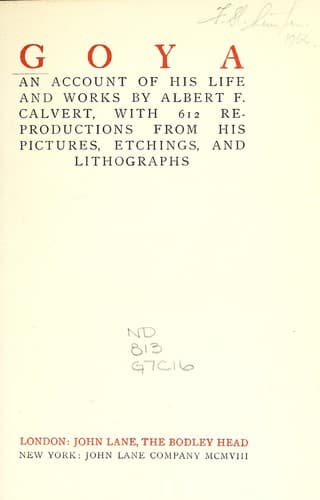
Goya, an account of his life and worksCalvert, Albert Frederick
History
Goya, an account of his life and works
Calvert, Albert Frederick
Goya, Francisco, 1746-1828
9. Children playing with a Bladder.
10. Children gathering Fruit.
11. A Blind Man playing the Guitar.
12. La Feria; or, the Fair of Madrid.
13. The Crockery Seller.
14. The Soldier and the Girl.
15. La Acerolera.
Girl passes through a group of men.
16. Playing at Soldiers.
17. Children playing with a Cart.
18. Playing at Pelota.
19. The See-Saw.
20. The Washerwomen.
21. La Novillada.
A village bull-fight.
22. The Dog.
23. The Fountain.
24. The Tobacco Guard (Preventive Service).
25. The Child in the Tree.
26. The Child and the Bird.
27. The Woodcutters.
28. The Singer.
29. The Rendezvous.
30. The Doctor.
31. The Flower-Girl.
32. The Harvesters.
33. The Vintagers.
34. The Wounded Mason.
35. The Poor Woman.
36. The Snow.
37. A Village Wedding.
38. Women at the Fountain.
39. Playing at Giants.
40. The Swing.
41. Fighting on Stilts.
42. Girls tossing a Manikin in a Sheet.
43. Children climbing a Tree.
44. Blindman’s-Buff.
45. Child on a Sheep.
(46. The Hunter and his Dogs.)
Sometimes included in the list.
THE CAPRICES (LOS CAPRICHOS)
A set of eighty engravings in aqua-fortis and aqua-tinta, executed
between 1796 and 1812. A facsimile edition was published by the Artistic
Library of Barcelona in 1885, and another by Messrs. Boussod and Valadon
at Paris in 1888:--
1. Francisco Goya y Lucientes, Painter.
2. El sí pronuncian....
‘They say yes, and give their hand to the man that first presents
himself.’
3. Que viene el Coco.
‘Here comes the Bogey!’
4. El de la Rollona.
A lackey with a man dressed as a child in leading-strings. Believed to
symbolise the helplessness and dependence of the rich on their servants.
5. Tal para qual.
‘Birds of a feather flock together.’
6. Nadie se conoce.
Masked persons in conversation. Supposed to suggest that in this world
we know each other only by appearances, which are really misleading.
7. Ni así la distingue.
‘Not thus can he distinguish her.’ A gallant scanning a young woman
through an eye-glass. Similar meaning to preceding.
8. Que se la llevaron.
‘Kidnapped!’ A woman carried off by masked and hooded men.
9. Tántalo.
‘Tantalus.’ A man, wringing his hands, supports a swooning woman.
Possibly points the same moral as the saying, _Si vieillesse
pouvait...._
10. El amor y la muerte.
‘Love and death.’ A woman supporting a dying man.
11. Muchachos al aíro.
Four Andalusian brigands seated round a tree.
12. A caza de dientes.
‘Tooth-hunting.’ A woman trying to extract the tooth of a man hanging.
13. Están calientes.
‘They are hot.’ Monks at table. An ironical suggestion in the title.
14. Qué sacrificio!
‘What a sacrifice!’ Young girl bestowed in marriage on an ugly old man.
15. Bellos consejos.
‘Good counsel.’ Duenna gives worldly advice to a young girl, who listens
with attention.
16. Dios la perdone....
‘May God pardon her--it was her mother.’ Young lady turns scornfully
from a beggar-woman. A rebuke to upstarts, forgetful of the ties of
kindred.
Public-domain text, read in full here on John Shaqi.
Reviews
Reviews
No reviews yet
Be the first to share your thoughts on this work.
Elsewhere in the archive
Join the Discussion
Join the discussion
Sign in to leave a comment or review.
Sign InorCreate an account