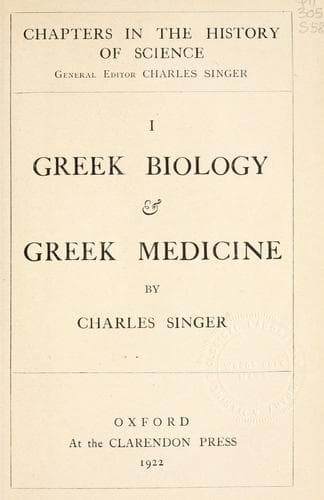
Biology -- Greece -- History; Medicine, Greek and Roman
Texts of Hippocrates and of Galen had formed an integral part in the
medical instruction of the universities from their commencement in
the thirteenth century. The first Greek text of the _Aphorisms_ of
Hippocrates appeared in 1532, edited by no less a hand than that of
François Rabelais. With the further recovery of the Greek texts and
preparation of better translations, these became almost the sole mode
of instruction during the fifteenth and sixteenth centuries. The
translators became legion and their competence varied. One highly
skilled translator, however, is of special interest to English
readers. Thomas Linacre (1460?-1524), Physician to Henry VIII, Tutor
to the Princess Mary, founder and first president of the College of
Physicians, a benefactor of both the ancient Universities and one
of the earliest, ablest, most typical, and most exasperating of the
English humanists, spent much energy on this work of translation for
which his abilities peculiarly fitted him. He was responsible for
no less than six important works of Galen, of which one, the _De
temperamentis et de inaequali intemperie_, printed at Cambridge in
1521, was among the earliest books impressed in that town and is said
to be the first printed in England for which Greek types were used. It
has been honoured by reproduction in facsimile in modern times. Such
works as these, purely literary efforts, had great vogue for a century
and more, and were much in use in the Universities. These humanistic
products sometimes produced, among the advocates of the new scientific
method, a degree of fury which was only rivalled by that of some of
the humanists themselves towards the translators from the Arabic. But
these are now dead fires. As the clinical and scientific methods of
teaching gained ground, textual studies receded in medical education,
as Hippocrates and Galen themselves would have wished them to recede.
The texts of Hippocrates and Galen have now ceased to occupy a place in
any medical curriculum. Yet all who know these writings, know too, not
only that their spirit is still with us, but that the works themselves
form the background of modern practice, and that their very phraseology
is still in use at the bedside. Modern medicine may be truly described
as in essence a creation of the Greeks. To realize the nature of our
medical system, some knowledge of its Greek sources is essential. It
would indeed be a bad day for medicine if ever this debt to the Greeks
were forgotten, and the loss would be at least as much ethical as
intellectual. But there is happily no fear of this, for the figure and
spirit of Hippocrates are more real and living to-day than they have
been since the great collapse of the Greek scientific intellect in the
third and fourth centuries of the Christian era.
PRINTED IN ENGLAND
AT THE OXFORD UNIVERSITY PRESS
Public-domain text, read in full here on John Shaqi.
Reviews
Reviews
No reviews yet
Be the first to share your thoughts on this work.
Elsewhere in the archive
Join the Discussion
Join the discussion
Sign in to leave a comment or review.
Sign InorCreate an account