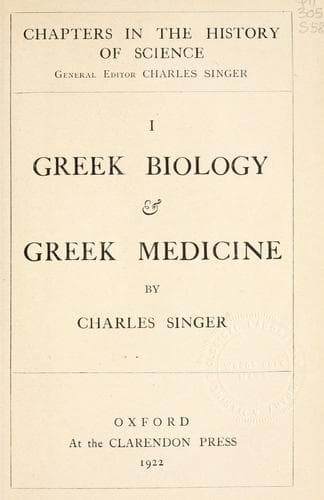
Biology -- Greece -- History; Medicine, Greek and Roman
Until the end of the fifteenth century progress in anatomy was
almost imperceptible. During the fifteenth century more Galenic and
Hippocratic texts were recovered and gradually turned into Latin, but
still without vitally affecting the course of Anatomy. The actual
printing of collected editions of Hippocrates and Galen came rather
late, for the debased taste of the Renaissance physicians continued to
prefer Dioscorides and the Arabs, of whom numerous editions appeared,
so that medicine made no advance corresponding to the progress of
scholarship. The Hippocratic works were first printed in 1525, and an
isolated edition of the inferior Galen in 1490, but the real advance
in Medicine was not made by direct study of these works. So long as
they were treated in the old scholastic spirit such works were of
no more value than those of the Arabists or others inherited from
the Middle Ages. Even Hippocrates can be spoilt by a commentary, and
it was not until the investigator began actually to compare his own
observations with those of Hippocrates and Galen that the real value
of these works became apparent. The department in which this happened
first was Anatomy, and such revolutionaries as Leonardo da Vinci
(1452-1518), who never published, and Vesalius (1514-1564), whose
great work appeared in 1543, were really basing their work on Galen,
though they were much occupied in proving Galen’s errors. Antonio
Benivieni (died 1502), an eager prophet of the new spirit, revived the
Hippocratic tradition by actually collecting notes of a few cases with
accompanying records of deaths and post-mortem findings, among which it
is interesting to observe a case of appendicitis.[141] His example was
occasionally followed during the sixteenth century, as for instance,
by the Portuguese Jewish physician Amatus Lusitanus (1511-_c._ 1562),
who printed no fewer than seven hundred cases; but the real revival
of the Hippocratic tradition came in the next century with Sydenham
(1624-1689) and Boerhaave (1668-1738), who were consciously working
on the Hippocratic basis and endeavouring to extend the Hippocratic
experience.
[141] Benivieni’s notes were published posthumously. Some of the
spurious Greek works of the Hippocratic collection have also case
notes.
Lastly surgery came to profit by the revival. The greatest of the
sixteenth century surgeons, the lovable and loving Ambroise Paré
(1510-1590), though he was, as he himself humbly confessed, an ignorant
man knowing neither Latin nor Greek, can be shown to have derived much
from the works of antiquity, which were circulating in translation in
his day and were thus filtering down to the unlearned.
Public-domain text, read in full here on John Shaqi.
Reviews
Reviews
No reviews yet
Be the first to share your thoughts on this work.
Elsewhere in the archive
Join the Discussion
Join the discussion
Sign in to leave a comment or review.
Sign InorCreate an account