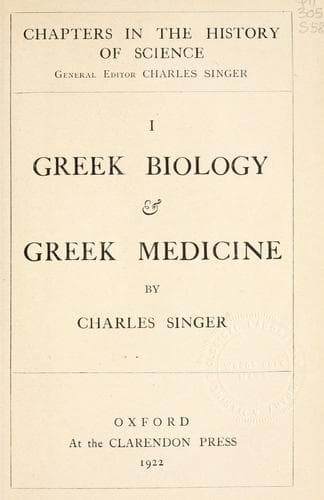
Biology -- Greece -- History; Medicine, Greek and Roman
Later Galen and Hippocrates became a little more accessible, not by
translation from the Greek, but by translation from the Arabic of a
Syriac version. The first work to be so rendered was a version of
_Aphorisms_ of Hippocrates which, however, as we have seen, were
already available in Latin dress, together with the Hippocratic
_Regimen in acute diseases_, and certain works of Galen as corruptly
interpreted by Isaac Judaeus. These were rendered from Arabic into
Latin by Constantine, an African adventurer who became a monk at Monte
Cassino and died there in 1087. Constantine was a wretched craftsman
with an imperfect knowledge of both Arabic and Latin. More effective
was the great twelfth century translator from the Arabic, Gerard of
Cremona (died 1185), who turned many medical works into Latin from
Arabic, and who was followed by a whole host of imitators. Yet more
important for the advance of medicine, however, was the learned
revival of the thirteenth century. In the main that revival was based
on translations from Arabic, but a certain number of works were
also rendered direct from the Greek. During the thirteenth century
Aristotle’s scientific works began to be treated in this way, but more
important for the course of medicine were those of Galen, and they had
to wait till the following century. The long treatise of Galen, περὶ
χρείας τῶν ἐν ἀνθρώπου σώματι μορίων, _On the uses of the bodily parts
in man_, was translated from the Greek into Latin by Nicholas of Reggio
in the earlier part of the fourteenth century. This work, with all its
defects, was by far the best account of the human body then available.
Many manuscripts of the Latin version have survived, and it was
translated into several vernaculars, including English, and profoundly
influenced surgery. The rendering into Latin of this treatise, and
its wide distribution, may be regarded as the starting-point of
modern scientific medicine. Its appearance is moreover a part of the
phenomenon of the revived interest in dissection which had begun to be
practised in the Universities in the thirteenth century,[139] and was a
generally accepted discipline in the fourteenth and fifteenth.[140]
[139] Dissection of animals was practised at Salerno as early as the
eleventh century.
[140] The sources of the anatomical knowledge of the Middle Ages
are discussed in detail in the following works: R. R. von Töply,
_Studien zur Geschichte der Anatomie im Mittelalter_, Vienna, 1898;
K. Sudhoff, _Tradition und Naturbeobachtung_, Leipzig, 1907; and
also numerous articles in the _Archiv für Geschichte der Medizin und
Naturwissenschaften_; Charles Singer, ‘A Study in Early Renaissance
Anatomy’, in _Studies in the History and Method of Science_, vol. i,
Oxford, 1917.
Public-domain text, read in full here on John Shaqi.
Reviews
Reviews
No reviews yet
Be the first to share your thoughts on this work.
Elsewhere in the archive
Join the Discussion
Join the discussion
Sign in to leave a comment or review.
Sign InorCreate an account