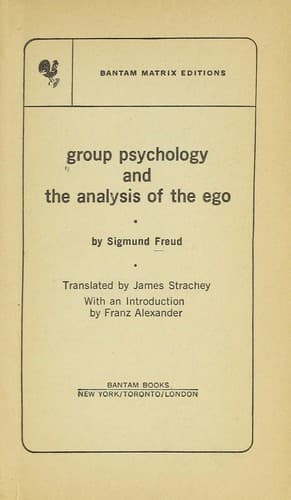
Group Psychology and The Analysis of The EgoFreud, Sigmund
Science
Group Psychology and The Analysis of The Ego
Freud, Sigmund
Ego (Psychology); Psychoanalysis; Social psychology
As regards intellectual work it remains a fact, indeed, that great
decisions in the realm of thought and momentous discoveries and
solutions of problems are only possible to an individual, working in
solitude. But even the group mind is capable of genius in intellectual
creation, as is shown above all by language itself, as well as by
folk-song, folk-lore and the like. It remains an open question,
moreover, how much the individual thinker or writer owes to the
stimulation of the group in which he lives, or whether he does more than
perfect a mental work in which the others have had a simultaneous share.
In face of these completely contradictory accounts, it looks as though
the work of Group Psychology were bound to come to an ineffectual end.
But it is easy to find a more hopeful escape from the dilemma. A number
of very different formations have probably been merged under the term
'group' and may require to be distinguished. The assertions of Sighele,
Le Bon and the rest relate to groups of a short-lived character, which
some passing interest has hastily agglomerated out of various sorts of
individuals. The characteristics of revolutionary groups, and
especially those of the great French Revolution, have unmistakably
influenced their descriptions. The opposite opinions owe their origin to
the consideration of those stable groups or associations in which
mankind pass their lives, and which are embodied in the institutions of
society. Groups of the first kind stand in the same sort of relation to
those of the second as a high but choppy sea to a ground swell.
McDougall, in his book on _The Group Mind_,[19] starts out from the same
contradiction that has just been mentioned, and finds a solution for it
in the factor of organisation. In the simplest case, he says, the
'group' possesses no organisation at all or one scarcely deserving the
name. He describes a group of this kind as a 'crowd'. But he admits that
a crowd of human beings can hardly come together without possessing at
all events the rudiments of an organisation, and that precisely in these
simple groups many of the fundamental facts of Collective Psychology can
be observed with special ease (p. 22). Before the members of a random
crowd of people can constitute something in the nature of a group in the
psychological sense of the word, a condition has to be fulfilled; these
individuals must have something in common with one another, a common
interest in an object, a similar emotional bias in some situation or
other, and ('consequently', I should like to interpolate) 'some degree
of reciprocal influence' (p. 23). The higher the degree of 'this mental
homogeneity', the more readily do the individuals form a psychological
group, and the more striking are the manifestations of a group mind.
Public-domain text, read in full here on John Shaqi.
Reviews
Reviews
No reviews yet
Be the first to share your thoughts on this work.
Join the Discussion
Join the discussion
Sign in to leave a comment or review.
Sign InorCreate an account