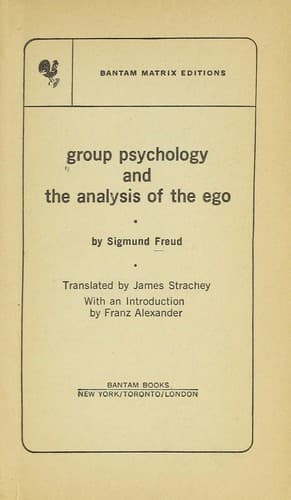
Group Psychology and The Analysis of The EgoFreud, Sigmund
Science
Group Psychology and The Analysis of The Ego
Freud, Sigmund
Ego (Psychology); Psychoanalysis; Social psychology
In connection with this question of being in love we have always been
struck by the phenomenon of sexual over-estimation--the fact that the
loved object enjoys a certain amount of freedom from criticism, and that
all its characteristics are valued more highly than those of people who
are not loved, or than its own were at a time when it itself was not
loved. If the sensual tendencies are somewhat more effectively
repressed or set aside, the illusion is produced that the object has
come to be sensually loved on account of its spiritual merits, whereas
on the contrary these merits may really only have been lent to it by its
sensual charm.
The tendency which falsifies judgement in this respect is that of
_idealisation_. But this makes it easier for us to find our way about.
We see that the object is being treated in the same way as our own ego,
so that when we are in love a considerable amount of narcissistic libido
overflows on to the object. It is even obvious, in many forms of love
choice, that the object serves as a substitute for some unattained ego
ideal of our own. We love it on account of the perfections which we have
striven to reach for our own ego, and which we should now like to
procure in this roundabout way as a means of satisfying our narcissism.
If the sexual over-estimation and the being in love increase even
further, then the interpretation of the picture becomes still more
unmistakable. The tendencies whose trend is towards directly sexual
satisfaction may now be pushed back entirely, as regularly happens, for
instance, with the young man's sentimental passion; the ego becomes more
and more unassuming and modest, and the object more and more sublime and
precious, until at last it gets possession of the entire self-love of
the ego, whose self-sacrifice thus follows as a natural consequence. The
object has, so to speak, consumed the ego. Traits of humility, of the
limitation of narcissism, and of self-injury occur in every case of
being in love; in the extreme case they are only intensified, and as a
result of the withdrawal of the sensual claims they remain in solitary
supremacy.
This happens especially easily with love that is unhappy and cannot be
satisfied; for in spite of everything each sexual satisfaction always
involves a reduction in sexual over-estimation. Contemporaneously with
this 'devotion' of the ego to the object, which is no longer to be
distinguished from a sublimated devotion to an abstract idea, the
functions allotted to the ego ideal entirely cease to operate. The
criticism exercised by that faculty is silent; everything that the
object does and asks for is right and blameless. Conscience has no
application to anything that is done for the sake of the object; in the
blindness of love remorselessness is carried to the pitch of crime. The
whole situation can be completely summarised in a formula: _The object
has taken the place of the ego ideal._
Public-domain text, read in full here on John Shaqi.
Reviews
Reviews
No reviews yet
Be the first to share your thoughts on this work.
Join the Discussion
Join the discussion
Sign in to leave a comment or review.
Sign InorCreate an account