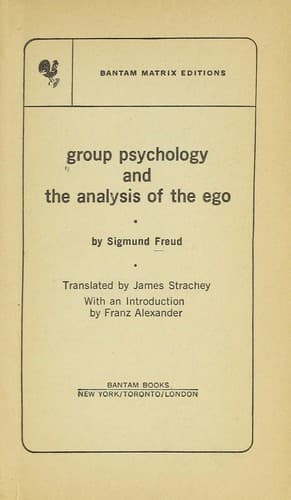
Group Psychology and The Analysis of The EgoFreud, Sigmund
Science
Group Psychology and The Analysis of The Ego
Freud, Sigmund
Ego (Psychology); Psychoanalysis; Social psychology
In this place I shall only follow up one of the consequences which seem
possible from this point of view, thus resuming the discussion of a
problem which I was obliged to leave unsolved elsewhere.[61] Each of the
mental differentiations that we have become acquainted with represents a
fresh aggravation of the difficulties of mental functioning, increases
its instability, and may become the starting-point for its breakdown,
that is, for the onset of a disease. Thus, by being born we have made
the step from an absolutely self-sufficient narcissism to the perception
of a changing outer world and to the beginnings of the discovery of
objects. And with this is associated the fact that we cannot endure the
new state of things for long, that we periodically revert from it, in
our sleep, to our former condition of absence of stimulation and
avoidance of objects. It is true, however, that in this we are following
a hint from the outer world, which, by means of the periodical change of
day and night, temporarily withdraws the greater part of the stimuli
that affect us. The second example, which is pathologically more
important, is not subject to any such qualification. In the course of
our development we have effected a separation of our mental existence
into a coherent ego and into an unconscious and repressed portion which
is left outside it; and we know that the stability of this new
acquisition is exposed to constant shocks. In dreams and in neuroses
what is thus excluded knocks for admission at the gates, guarded though
they are by resistances; and in our waking health we make use of special
artifices for allowing what is repressed to circumvent the resistances
and for receiving it temporarily into our ego to the increase of our
pleasure. Wit and humour, and to some extent the comic in general, may
be regarded in this light. Everyone acquainted with the psychology of
the neuroses will think of similar examples of less importance; but I
hasten on to the application I have in view.
It is quite conceivable that the separation of the ego ideal from the
ego cannot be borne for long either, and has to be temporarily undone.
In all renunciations and limitations imposed upon the ego a periodical
infringement of the prohibition is the rule; this indeed is shown by the
institution of festivals, which in origin are nothing more nor less than
excesses provided by law and which owe their cheerful character to the
release which they bring.[62] The Saturnalia of the Romans and our
modern carnival agree in this essential feature with the festivals of
primitive people, which usually end in debaucheries of every kind and
the transgression of what are at other times the most sacred
commandments. But the ego ideal comprises the sum of all the limitations
in which the ego has to acquiesce, and for that reason the abrogation of
the ideal would necessarily be a magnificent festival for the ego, which
might then once again feel satisfied with itself.[63]
Public-domain text, read in full here on John Shaqi.
Reviews
Reviews
No reviews yet
Be the first to share your thoughts on this work.
Elsewhere in the archive
Join the Discussion
Join the discussion
Sign in to leave a comment or review.
Sign InorCreate an account