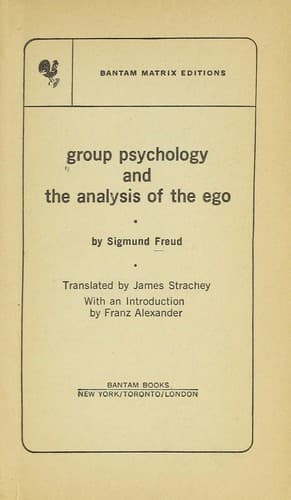
Group Psychology and The Analysis of The EgoFreud, Sigmund
Science
Group Psychology and The Analysis of The Ego
Freud, Sigmund
Ego (Psychology); Psychoanalysis; Social psychology
There is always a feeling of triumph when something in the ego coincides
with the ego ideal. And the sense of guilt (as well as the sense of
inferiority) can also be understood as an expression of tension between
the ego and the ego ideal.
It is well known that there are people the general colour of whose mood
oscillates periodically from an excessive depression through some kind
of intermediate state to an exalted sense of well-being. These
oscillations appear in very different degrees of amplitude, from what is
just noticeable to those extreme instances which, in the shape of
melancholia and mania, make the most painful or disturbing inroads upon
the life of the person concerned. In typical cases of this cyclical
depression outer exciting causes do not seem to play any decisive part;
as regards inner motives, nothing more (or nothing different) is to be
found in these patients than in all others. It has consequently become
the custom to consider these cases as not being psychogenic. We shall
refer later on to those other exactly similar cases of cyclical
depression which can nevertheless easily be traced back to mental
traumata.
Thus the foundation of these spontaneous oscillations of mood is
unknown; we are without insight into the mechanism of the displacement
of a melancholia by a mania. So we are free to suppose that these
patients are people in whom our conjecture might find an actual
application--their ego ideal might be temporarily resolved into their
ego after having previously ruled it with especial strictness.
Let us keep to what is clear: On the basis of our analysis of the ego it
cannot be doubted that in cases of mania the ego and the ego ideal have
fused together, so that the person, in a mood of triumph and
self-satisfaction, disturbed by no self-criticism, can enjoy the
abolition of his inhibitions, his feelings of consideration for others,
and his self-reproaches. It is not so obvious, but nevertheless very
probable, that the misery of the melancholiac is the expression of a
sharp conflict between the two faculties of his ego, a conflict in which
the ideal, in an excess of sensitiveness, relentlessly exhibits its
condemnation of the ego in delusions of inferiority and in
self-depreciation. The only question is whether we are to look for the
causes of these altered relations between the ego and the ego ideal in
the periodic rebellions, which we have postulated above, against the new
institution, or whether we are to make other circumstances responsible
for them.
Public-domain text, read in full here on John Shaqi.
Reviews
Reviews
No reviews yet
Be the first to share your thoughts on this work.
Elsewhere in the archive
Join the Discussion
Join the discussion
Sign in to leave a comment or review.
Sign InorCreate an account