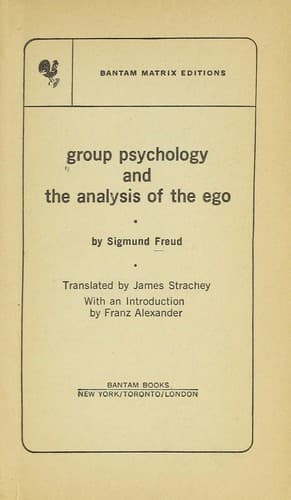
Group Psychology and The Analysis of The EgoFreud, Sigmund
Science
Group Psychology and The Analysis of The Ego
Freud, Sigmund
Ego (Psychology); Psychoanalysis; Social psychology
A change into mania is not an indispensable feature of the
symptomatology of melancholic depression. There are simple melancholias,
some in single and some in recurring attacks, which never show this
development. On the other hand there are melancholias in which the
exciting cause clearly plays an aetiological part. They are those which
occur after the loss of a loved object, whether by death or as a result
of circumstances which have necessitated the withdrawal of the libido
from the object. A psychogenic melancholia of this sort can end in
mania, and this cycle can be repeated several times, just as easily as
in a case which appears to be spontaneous. Thus the state of things is
somewhat obscure, especially as only a few forms and cases of
melancholia have been submitted to psycho-analytical investigation.[64]
So far we only understand those cases in which the object is given up
because it has shown itself unworthy of love. It is then set up again
inside the ego, by means of identification, and severely condemned by
the ego ideal. The reproaches and attacks directed towards the object
come to light in the shape of melancholic self-reproaches.[65]
A melancholia of this kind may also end in a change to mania; so that
the possibility of this happening represents a feature which is
independent of the other characteristics in the symptomatology.
Nevertheless I see no difficulty in assigning to the factor of the
periodical rebellion of the ego against the ego ideal a share in both
kinds of melancholia, the psychogenic as well as the spontaneous. In the
spontaneous kind it may be supposed that the ego ideal is inclined to
display a peculiar strictness, which then results automatically in its
temporary suspension. In the psychogenic kind the ego would be incited
to rebellion by ill-treatment on the part of its ideal--an ill-treatment
which it encounters when there has been identification with a rejected
object.
XII
POSTSCRIPT
In the course of the enquiry which has just been brought to a
provisional end we came across a number of side-paths which we avoided
pursuing in the first instance but in which there was much that offered
us promises of insight. We propose now to take up a few of the points
that have been left on one side in this way.
A. The distinction between identification of the ego with an object and
replacement of the ego ideal by an object finds an interesting
illustration in the two great artificial groups which we began by
studying, the army and the Christian church.
It is obvious that a soldier takes his superior, that is, really, the
leader of the army, as his ideal, while he identifies himself with his
equals, and derives from this community of their egos the obligations
for giving mutual help and for sharing possessions which comradeship
implies. But he becomes ridiculous if he tries to identify himself with
the general. The soldier in _Wallensteins Lager_ laughs at the sergeant
for this very reason:
Public-domain text, read in full here on John Shaqi.
Reviews
Reviews
No reviews yet
Be the first to share your thoughts on this work.
Elsewhere in the archive
Join the Discussion
Join the discussion
Sign in to leave a comment or review.
Sign InorCreate an account