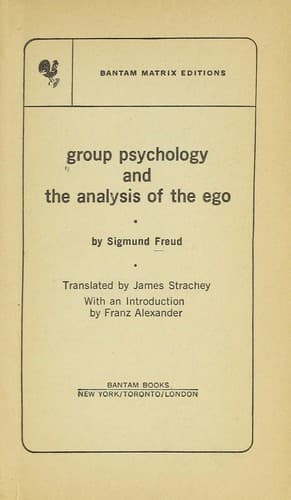
Group Psychology and The Analysis of The EgoFreud, Sigmund
Science
Group Psychology and The Analysis of The Ego
Freud, Sigmund
Ego (Psychology); Psychoanalysis; Social psychology
[49] Cf. 'Metapsychologische Ergänzung zur Traumlehre.' _Kleine
Schriften zur Neurosenlehre_, Vierte Folge, 1918.
[50] W. Trotter: _Instincts of the Herd in Peace and War._ Fisher Unwin,
1916.
[51] See my essay _Jenseits des Lustprinzips_.
[52] See the remarks upon Dread in _Vorlesungen zur Einführung in die
Psychoanalyse_. XXV.
[53] _Totem und Tabu._
[54] What we have just described in our general characterisation of
mankind must apply especially to the primal horde. The will of the
individual was too weak; he did not venture upon action. No impulses
whatever came into play except collective ones; there was only a common
will, there were no single ones. An idea did not dare to turn itself
into a volition unless it felt itself reinforced by a perception of its
general diffusion. This weakness of the idea is to be explained by the
strength of the emotional tie which is shared by all the members of the
horde; but the similarity in the circumstances of their life and the
absence of any private property assist in determining the uniformity of
their individual mental acts. As we may observe with children and
soldiers, common activity is not excluded even in the excremental
functions. The one great exception is provided by the sexual act, in
which a third person is at the best superfluous and in the extreme case
is condemned to a state of painful expectancy. As to the reaction of the
sexual need (for genital gratification) towards gregariousness, see
below.
[55] It may perhaps also be assumed that the sons, when they were driven
out and separated from their father, advanced from identification with
one another to homosexual object love, and in this way won freedom to
kill their father.
[56] 'Das Unheimliche.' _Imago_, 1919, Bd. V.
[57] See _Totem und Tabu_ and the sources there quoted.
[58] This situation, in which the subject's attitude is unconsciously
directed towards the hypnotist, while he is consciously occupied with
the monotonous and uninteresting perceptions, finds a parallel among the
events of psycho-analytic treatment, which deserves to be mentioned
here. At least once in the course of every analysis a moment comes when
the patient obstinately maintains that just now positively nothing
whatever occurs to his mind. His free associations come to a stop and
the usual incentives for putting them in motion fail in their effect. As
a result of pressure the patient is at last induced to admit that he is
thinking of the view from the consulting-room window, of the wall-paper
that he sees before him, or of the gas-lamp hanging from the ceiling.
Then one knows at once that he has gone off into the transference and
that he is engaged upon what are still unconscious thoughts relating to
the physician; and one sees the stoppage in the patient's associations
disappear, as soon as he has been given this explanation.
Public-domain text, read in full here on John Shaqi.
Reviews
Reviews
No reviews yet
Be the first to share your thoughts on this work.
Elsewhere in the archive
Join the Discussion
Join the discussion
Sign in to leave a comment or review.
Sign InorCreate an account