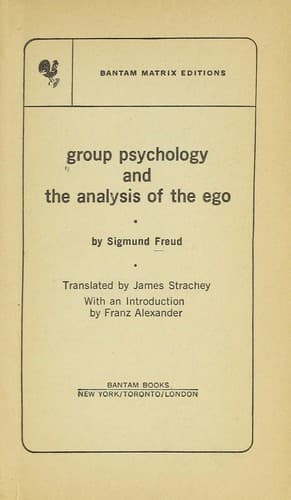
Group Psychology and The Analysis of The EgoFreud, Sigmund
Science
Group Psychology and The Analysis of The Ego
Freud, Sigmund
Ego (Psychology); Psychoanalysis; Social psychology
In order to make a correct judgement upon the morals of groups, one must
take into consideration the fact that when individuals come together in
a group all their individual inhibitions fall away and all the cruel,
brutal and destructive instincts, which lie dormant in individuals as
relics of a primitive epoch, are stirred up to find free gratification.
But under the influence of suggestion groups are also capable of high
achievements in the shape of abnegation, unselfishness, and devotion to
an ideal. While with isolated individuals personal interest is almost
the only motive force, with groups it is very rarely prominent. It is
possible to speak of an individual having his moral standards raised by
a group (p. 65). Whereas the intellectual capacity of a group is always
far below that of an individual, its ethical conduct may rise as high
above his as it may sink deep below it.
Some other features in Le Bon's description show in a clear light how
well justified is the identification of the group mind with the mind of
primitive people. In groups the most contradictory ideas can exist side
by side and tolerate each other, without any conflict arising from the
logical contradiction between them. But this is also the case in the
unconscious mental life of individuals, of children and of neurotics, as
psycho-analysis has long pointed out.[14]
A group, further, is subject to the truly magical power of words; they
can evoke the most formidable tempests in the group mind, and are also
capable of stilling them (p. 117). 'Reason and arguments are incapable
of combating certain words and formulas. They are uttered with solemnity
in the presence of groups, and as soon as they have been pronounced an
expression of respect is visible on every countenance, and all heads are
bowed. By many they are considered as natural forces, as supernatural
powers.' (p. 117.) It is only necessary in this connection to remember
the taboo upon names among primitive people and the magical powers which
they ascribe to names and words.[15]
And, finally, groups have never thirsted after truth. They demand
illusions, and cannot do without them. They constantly give what is
unreal precedence over what is real; they are almost as strongly
influenced by what is untrue as by what is true. They have an evident
tendency not to distinguish between the two (p. 77).
Public-domain text, read in full here on John Shaqi.
Reviews
Reviews
No reviews yet
Be the first to share your thoughts on this work.
Join the Discussion
Join the discussion
Sign in to leave a comment or review.
Sign InorCreate an account