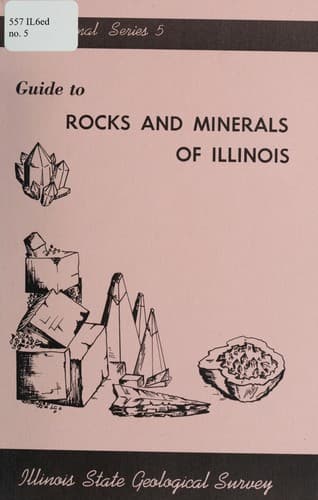
Guide to Rocks and Minerals of IllinoisIllinois State Geological Survey
Science
Guide to Rocks and Minerals of Illinois
Illinois State Geological Survey
Mineralogy -- Illinois; Petrology -- Illinois
CENOZOIC “Recent Life”
Age of Mammals
Quaternary
0-500′
Pleistocene or Glacial Age
Recent—alluvium in river valleys
Glacial till, glacial outwash, gravel, sand,
silt lake deposits of clay and silt, loess and
sand dunes; covers nearly all of state except
northwest corner and southern tip
Tertiary
0-500′
Pliocene Chert gravel; present in northern, southern, and
western Illinois
Eocene Mostly micaceous sand with some silt and clay;
present only in southern Illinois
Paleocene Mostly clay, little sand; present only in
southern Illinois
MESOZOIC “Middle Life”
Age of Reptiles
Cretaceous Mostly sand, some thin beds of clay and,
0-300′ locally, gravel; present only in southern
Illinois
PALEOZOIC “Ancient Life”
Age of Amphibians and Early Plants
Pennsylvanian Largely shale and sandstone with beds of coal,
0-3,000′ limestone, and clay
(“Coal Measures”)
Mississippian Black and gray shale at base; middle zone of
0-3,500′ thick limestone that grades to siltstone, chert,
and shale; upper zone of interbedded sandstone,
shale and limestone
Age of Fishes
Devonian Thick limestone, minor sandstones and shales;
0-1,500′ largely chert and cherty limestone in southern
Illinois
Age of Invertebrates
Silurian Principally dolomite and limestone
0-1,000′
Ordovician Largely dolomite and limestone but contains
500-2,000′ sandstone, shale, and siltstone formations
Cambrian Chiefly sandstones with some dolomite and shale;
1,500-3,000′ exposed only in small areas in north-central
Illinois
ARCHEOZOIC and PROTEROZOIC
Igneous and metamorphic rocks; known in Illinois
only from deep wells
As shown by the diagrammatic rock column (fig. 2), rocks placed in the
divisions called early Cenozoic and Mesozoic are next in age to the
Pleistocene. The map (fig. 1) shows that the Cenozoic and Mesozoic rocks
occur only in the extreme southern tip of Illinois because only that
part of Illinois was covered by a northward extension of the forerunner
of the Gulf of Mexico in which the deposits of sand, gravel, and clay
were laid down.
The next older division of Illinois rocks is called Pennsylvanian—or
“Coal Measures”—because during the last century they were first
extensively described by geologists working in Pennsylvania.
Public-domain text, read in full here on John Shaqi.
Reviews
Reviews
No reviews yet
Be the first to share your thoughts on this work.
Join the Discussion
Join the discussion
Sign in to leave a comment or review.
Sign InorCreate an account