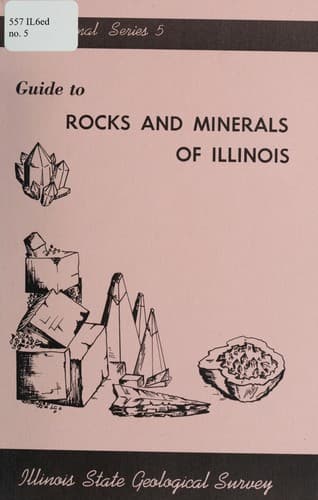
Guide to Rocks and Minerals of IllinoisIllinois State Geological Survey
Science
Guide to Rocks and Minerals of Illinois
Illinois State Geological Survey
Mineralogy -- Illinois; Petrology -- Illinois
A. Soft; spongy when wet; very lightweight when dry; forms in swampy
places
1) Fine mass with coarse plant fragments; dark gray to black
Peat (13)
2) Plant fragments small and not easily recognized; fine-grained;
black to dark gray; earthy
Muck
B. Hard but can be scratched with a knife
1) Black; contains bands of shiny and dull material; burns well
Coal (14)
2) Dark gray to black; does not contain shiny bands; splits into
thin sheets; burns poorly or not at all
Bituminous shale
EQUIPMENT FOR COLLECTING
1. Hammer (bricklayer’s) with one chisel or pick head.
2. Cold chisel about 6 inches long with an edge about ½-inch wide.
3. Dilute hydrochloric (muriatic) acid (10 percent solution) in a
dropper bottle for testing the presence of carbonate minerals.
Mark the bottle POISON. If acid is spilled on skin or clothing,
wipe immediately and, if possible, rinse with water.
4. Magnifying glass or hand lens—10 power is probably most useful.
5. Hardness testers—penny, square of window glass, pocket knife, or
nail.
6. Streak plate—piece of unglazed white porcelain (such as the back of a
tile) for testing the color of the streak of minerals.
7. Notebook and pencil for keeping records of the locality and bed from
which specimens are collected.
8. Collecting bag—a musette bag, a knapsack, or similar bag of strong
material.
9. Heavy gloves and goggles to protect hands and eyes.
10. Labels and wrappings. Field identification of specimens may be
written on adhesive tape and attached to the specimen or on a slip
of paper enclosed in the wrapping. Newspaper, brown paper, or
paper bags can be used for wrapping specimens. Label the outside
of the wrapped specimen too. Take only the best specimens home
with you. Trim specimens to hand size (about 2 by 3 inches).
All specimens should be labeled with the following information: name of
mineral or rock type, where found, collector’s name, and date. As
your collection grows, you may want to set up a system of
cataloging. List specimens and assign a number to each one. Place
a small amount of white enamel on a corner of each specimen; when
the enamel dries, number the sample with India ink; coat number
with lacquer. Corresponding numbers should be entered on your list
of specimens.
EDUCATIONAL EXTENSION PROGRAM
Public-domain text, read in full here on John Shaqi.
Reviews
Reviews
No reviews yet
Be the first to share your thoughts on this work.
Join the Discussion
Join the discussion
Sign in to leave a comment or review.
Sign InorCreate an account