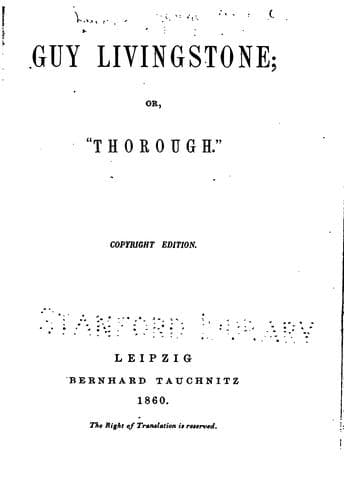
Guy Livingstone; or, 'Thorough'Lawrence, George A. (George Alfred)
General
Guy Livingstone; or, 'Thorough'
Lawrence, George A. (George Alfred)
Fiction
Now these men, unknown to their best friend perhaps, had gone through
the affliction which is so common that it is hard to speak of it without
launching into truisms. This sorrow has made some men famous, by forcing
them out into the world and shutting the door behind them. It has made
the fortunes of some poets, who choose the world for their confidant,
setting their bereavement to music, and bewailing Eurydice in charming
volumes, that are cheap at "3_s._ 6_d._ in cloth, lettered." It has made
some--I think the best and bravest--somewhat silent for the rest of
their lives. I read some lines the other day wise enough to have sprung
from an older brain than Owen Meredith's.
"They were pedants who could speak--
Grander souls have passed unheard;
Such as felt all language weak;
Choosing rather to record
Secrets before Heaven, than break
Faith with angels, by a word--"
Yes, many men have their Rachel; but--there being a prejudice against
bigamy--few have even the Patriarch's luck, to marry her at last; for
the wife _de convenance_ generally outlives her younger sister; and so,
one afternoon, we turn again from a grave in Ephrata-Green Cemetery,
somewhat drearily, into our tent pitched in the plains of Belgravia,
where Leah--(there was ever jealousy between those two)--meets us with a
sharp glance of triumph in her "tender eyes."
We have known pleasanter _tete-a-tetes_--have we not?--than that which
we undergo that evening at dinner, though our companion seems disposed
to be especially lively. We have not much appetite; but our _carissima
sposa_ tells us "not to drink any more claret, or we shall never be fit
to take her to Lady Shechem's _conversazione_." Of all nights in the
year, would she let us off duty on this one? "There are to be some very
pleasant people there," she says, "though none, perhaps, that _you
particularly care about_." (Thank you, my love; I understand that
good-natured allusion perfectly, and am proportionately grateful.) Her
voice sounds shriller than usual as she says this, and leaves us to put
some last touches to her toilette. So we order a fresh bottle,
notwithstanding the warning, and fall to thinking. How low and soft
_that other_ voice was, and, even when a little reproachful, how rarely
sweet! _She_ would scarcely have invented that last taunt if matters
had turned out differently. Then we think of our respected
father-in-law, Sir Joseph Leyburn, of Harran Park--a mighty county
magistrate and cattle-breeder. He got Ishmael Deadeye, the poacher,
transported last year, and took the prize for Devons at the Great
Mesopotamian Agricultural with a brindled bull. We remember his weeping
at the wedding-breakfast over the loss of his eldest treasure, and
wonder if he was an arrant humbug, or only a foolish, fond old man,
inclining morosely toward the former opinion. We don't seem to care much
about Sir Roland de Vaux, the celebrated geologist, whom we shall have
Public-domain text, read in full here on John Shaqi.
Reviews
Reviews
No reviews yet
Be the first to share your thoughts on this work.
Join the Discussion
Join the discussion
Sign in to leave a comment or review.
Sign InorCreate an account