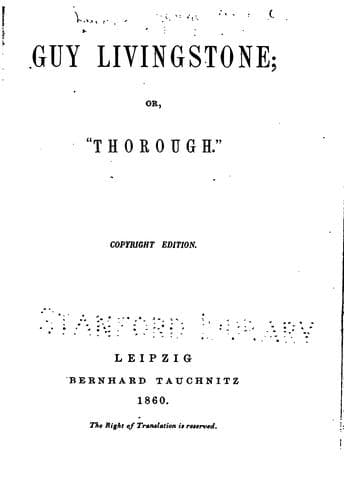
Guy Livingstone; or, 'Thorough'Lawrence, George A. (George Alfred)
General
Guy Livingstone; or, 'Thorough'
Lawrence, George A. (George Alfred)
Fiction
I hoped to have found him in a repentant mood, but his first words
undeceived me: "I start for Paris by this evening's train;" and then I
remarked all about me the signs of immediate departure.
I only had a confused idea of what had happened, and was anxious to know
the truth, but he was very brief in his answers: the particulars of what
had passed I learned long afterward.
"Can nothing be done?" I asked, when he had finished all he chose to
tell me.
"Nothing!" replied Livingstone, decisively. "If excuse or explanation
had been of any use, I think I should have tried them last night. You
would not advise me to humiliate myself to no purpose, I suppose?"
There is a certain scene in AEschylus which came into my mind just then.
A group of elderly men, with grave, rather vacuous faces, and grizzled
beards, stand in the court-yard of an ancient palace. On one side is the
peristyle, with its square stunted pillars, looking as if the weight
above crushed them, though it wearies them no more than the heavens do
Atlas; on the other, a gateway, vast, low-browed, shadowy with Cyclopean
stones. Somewhat apart is a strange weird figure, ever and anon starting
up and tossing her arms wildly as she utters some new denunciation, and
then cowering down again in a despairing weariness. There are traces yet
in the thin, wan face of the beauty which enslaved Loxian Apollo, and of
the pride which turned his great love into a greater hate: round it hang
the black elf-locks, disheveled, that have never been braided since the
gripe of Telamonian Ajax ruffled them so rudely. In her great, troubled
eyes you read terrible memories, and a prescience of coming
death--death, most grateful to the dishonored princess, but before which
the frail womanhood can not but shudder and quail. No wonder that the
reverend men glance at her uneasily, scarcely mustering courage enough
sometimes to answer her with a pious platitude. Alas! alas! Cassandra.
While we gaze, forth from the recesses of the gynaeceum there breaks a
cry, expressing rather wrath and surprise than mere pain. Then there
comes another, more plaintive--the moan of a strong man in the
death-throe.
We know that voice very well; we have heard it many times, calm and
regal, above the wrangle of councils and the roar of battle; often it
prayed for victory or for the people's weal, but it never yet called on
earth or heaven to help Agamemnon. The Chorus hear it too; but they
linger and palter, while each gives his grave sentence deliberately in
his proper turn. One or two advise action and interference, and stand
perfectly still. At last we hear a heavy, choking groan, and a great
stillness follows. We know that all is over--we know that there is a
stir already down there in Hades--we seem to catch a far-off murmur
raised by a thousand weak, tremulous voices--the very ghost of a
wail--as the shadows of those who died gallantly in their harness before
Troy gather to meet their old leader, the mightiest Atride.
Public-domain text, read in full here on John Shaqi.
Reviews
Reviews
No reviews yet
Be the first to share your thoughts on this work.
Elsewhere in the archive
Join the Discussion
Join the discussion
Sign in to leave a comment or review.
Sign InorCreate an account