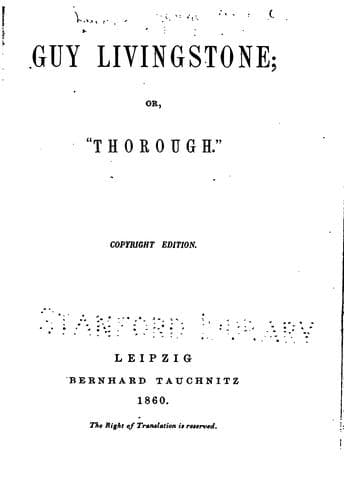
Guy Livingstone; or, 'Thorough'Lawrence, George A. (George Alfred)
General
Guy Livingstone; or, 'Thorough'
Lawrence, George A. (George Alfred)
Fiction
In the background of all we fancy a hideous Eidolon, from whose side
even the damned recoil in loathing. There is a grin on the lips yet red
and wet with the traces of the unholy banquet. Thyestes exalts over the
fulfillment of another chapter in the inevitable curse.
Who has not grown savage over that scene? We hate the old drivelers less
when, a few minutes later, they truckle and temporize with the awful
shape, who comes forth with a splash of blood on her slender wrist, and
a speck or two on her white, lofty forehead.
Just so helpless and useless I felt at that moment. I was standing by
while a foul wrong was being wrought. I saw nothing but ruin for Guy,
and desolate misery for Constance, in the black future. Yet I could
think of no argument or counsel that would in the least avail. I felt
sick at heart. It was some minutes before I answered his last question.
At last the words broke from me almost unconsciously: "Ah! how will you
answer to God and man for last night's work?"
I forgot that I was quoting the cry of the Covenanter's widow when she
knelt by her husband's corpse, and looked up into Claverhouse's face
with those sad eyes that were ever dim and cloudy after the carbines
flashed across them. But Guy remembered it, and answered instantly in
the words of his favorite hero,
"I can answer it to man well enough, and I will take God in my own
hand."
Years afterward we both recalled that fatal defiance, when the speaker
lay helpless, at the mercy of the Omnipotence whose might he challenged.
Just then his servant, who was busily preparing for departure, entered
the room.
Willis was a slight, under-sized man, of about fifty; his complexion was
muddy and indefinite; his small whiskers, of a grayish red, were trimmed
and pruned as accurately as a box border-edging, and the partial absence
of eyebrows and eyelashes gave his face a sort of unfinished look. The
expression natural to it was, I think, a low, vicious cunning; but his
features and little green eyes were so rigidly disciplined that, as a
rule, neither had any characteristic save utter vacuity. In his own line
he was perfect. No commission that could be intrusted to him would draw
from him a remark or a look of surprise. He executed precisely what he
was told, and fulfilled the minutest duties of his station
irreproachably, with a noiseless, feline activity. He was like the
war-horse of the Douglas:
"Though somewhat old,
Swift in his paces, cool, and bold."
He held a miniature-case in his hand as he entered. "Am I to put this
in, sir?" he asked, in the slow, measured voice that was habitual to
him.
His master gazed sharply at him, as if trying to detect a covert
sneer--it would have been safer to have stroked a rattlesnake's crest
than to have trifled with Livingstone just then--but Willis's face was
as innocent of any expression as a dead wall.
Public-domain text, read in full here on John Shaqi.
Reviews
Reviews
No reviews yet
Be the first to share your thoughts on this work.
Elsewhere in the archive
Join the Discussion
Join the discussion
Sign in to leave a comment or review.
Sign InorCreate an account