Wells, H. G. (Herbert George), 1866-1946 -- Criticism and interpretation
Produced by Juliet Sutherland, Melissa Er-Raqabi and the Online
Distributed Proofreading Team at https://www.pgdp.net.
[Illustration: H.G. WELLS]
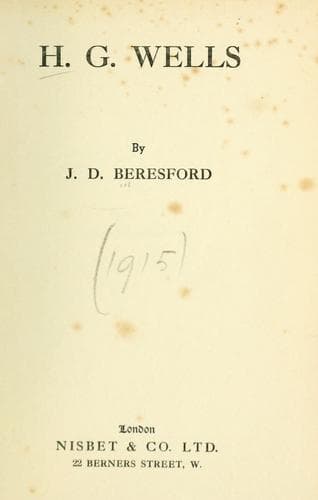
H.G. WELLS
By
J.D. BERESFORD
[Illustration]
NEW YORK
HENRY HOLT AND COMPANY
_First Published in 1915_
CONTENTS
PAGE
I. INTRODUCTION 9
II. THE ROMANCES 17
III. THE NOVELS 58
IV. SOCIOLOGY 97
BIBLIOGRAPHY 117
AMERICAN BIBLIOGRAPHY 121
INDEX 125
[Transcriber's Notes for e-book:
The spelling and punctuation are consistent with the original scans
with the following exceptions. If you are using this book for research, please
verify any spelling or punctuation with another source.
I added ["] at end of phrase: "to recover the full-bodied
self-satisfaction of his early days."
In the following sentence, I changed 'succeded' to 'succeeded': And
Bensington, the other experimenter, succeeded in separating a food
that produced regular instead of intermittent growth.]
TO
R.A.A.B.
THIS ESSAY IS FRATERNALLY
DEDICATED
I
INTRODUCTION
THE NORMALITY OF MR WELLS
In his Preface to the _Unpleasant Plays_, Mr Shaw boasts his
possession of "normal sight." The adjective is the oculist's, and the
application of it is Mr Shaw's, but while the phrase is misleading
until it is explained to suit a particular purpose, it has a pleasing
adaptability, and I can find none better as a key to the works of Mr
H.G. Wells.
We need not bungle over the word "normal," in any attempt to meet the
academic objection that it implies conformity to type. In this
connection, the gifted possessor of normal sight is differentiated
from his million neighbours by the fact that he wears no glasses; and
if a few happy people still exist here and there who have no need for
the mere physical assistance, the number of those whose mental outlook
is undistorted by tradition, prejudice or some form of bias is so
small that we regard them as inspired or criminal according to the
inclination of our own beloved predilection. And no spectacles will
correct the mental astigmatism of the multitude, a fact that is often
a cause of considerable annoyance to the possessors of normal sight.
That defect of vision, whether congenital or induced by the
confinements of early training, persists and increases throughout
life, like other forms of myopia. The man who sees a ball as slightly
flattened, like a tangerine orange too tightly packed (an "oblate
spheroid" would be the physicist's brief description), seeks the
society of other men who share his illusion; and the company of them
take arms against the opposing faction, which is confirmed in the
belief that the ball is egg-shaped, that the bulge, in fact, is not
"oblate" but "prolate."
Public-domain text, read in full here on John Shaqi.
Reviews
Reviews
No reviews yet
Be the first to share your thoughts on this work.
Join the Discussion
Join the discussion
Sign in to leave a comment or review.
Sign InorCreate an account