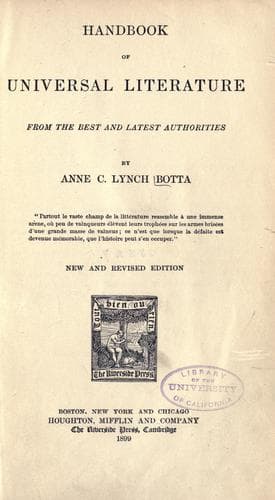
Handbook of Universal Literature, From the Best and Latest AuthoritiesBotta, Anne C. Lynch (Anne Charlotte Lynch)
History
Handbook of Universal Literature, From the Best and Latest Authorities
Botta, Anne C. Lynch (Anne Charlotte Lynch)
Literature -- History and criticism
The Bacchic festal costume, which the actors wore, consisted of long
striped garments reaching to the ground, over which were thrown upper
garments of some brilliant color, with gay trimmings and gold ornaments.
The choruses also vied with each other in the splendor of their dress, as
well as in the excellence of their singing and dancing. The chorus, which
always bore a subordinate part in the action of the tragedy, was in no
respect distinguished from the stature and appearance of ordinary men,
while the actor, who represented the god or hero, required to be raised
above the usual dimensions of mortals. A tragic actor was a strange, and,
according to the taste of the ancients themselves at a later period, a
very monstrous being. His person was lengthened out considerably beyond
the proportions of the human figure by the very high soles of the tragic
shoe, and by the length of the tragic mask, and the chest, body, legs, and
arms were stuffed and padded to a corresponding size; the body thus lost
much of its natural flexibility, and the gesticulation consisted of stiff,
angular movements, in which little was left to the emotion or the
inspiration of the moment. Masks, which had originated in the taste for
mumming and disguises of all sorts, prevalent at the Bacchic festivals,
were an indispensable accompaniment to tragedy. They not only concealed
the individual features of well-known actors, and enabled the spectators
entirely to forget the performer in his part, but gave to his whole aspect
that ideal character which the tragedy of antiquity demanded. The tragic
mask was not intentionally ugly and caricatured like the comic, but the
half-open mouth, the large eye-sockets, and sharply-defined features, in
which every characteristic was presented in its utmost strength, and the
bright and hard coloring were calculated to make the impression of a being
agitated by the emotions and passions of human nature in a degree far
above the standard of common life. The masks could, however, be changed
between the acts, so as to represent the necessary changes in the state or
emotions of the persons.
The ancient theatres were stone buildings of enormous size, calculated to
accommodate the whole free and adult population of a great city at the
spectacles and festal games. These theatres were not designed exclusively
for dramatic poetry; choral dances, processions, revels, and all sorts of
representations were held in them. We find theatres in every part of
Greece, though dramatic poetry was the peculiar growth of Athens.
Public-domain text, read in full here on John Shaqi.
Reviews
Reviews
No reviews yet
Be the first to share your thoughts on this work.
Elsewhere in the archive
Join the Discussion
Join the discussion
Sign in to leave a comment or review.
Sign InorCreate an account