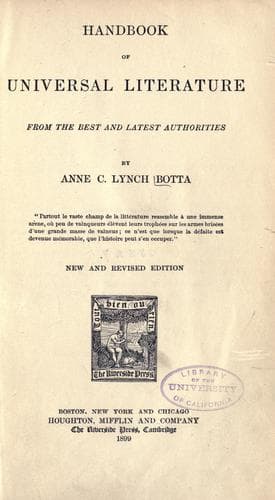
Handbook of Universal Literature, From the Best and Latest AuthoritiesBotta, Anne C. Lynch (Anne Charlotte Lynch)
History
Handbook of Universal Literature, From the Best and Latest Authorities
Botta, Anne C. Lynch (Anne Charlotte Lynch)
Literature -- History and criticism
The whole structure of the theatre, as well as the drama itself, may be
traced to the chorus, whose station was the original centre of the whole
performance. The orchestra, which occupied a circular level space in the
centre of the building, grew out of the chorus or dancing-place of the
Homeric times. The altar of Bacchus, around which the dithyrambic chorus
danced in a circle, had given rise to a sort of raised platform in the
centre of the orchestra, which served as a resting-place for the chorus.
The chorus sang alone when the actors had quitted the stage, or
alternately with the persons of the drama, and sometimes entered into
dialogues with them. These persons represented heroes of the mythical
world, whose whole aspect bespoke something mightier and more sublime than
ordinary humanity, and it was the part of the chorus to show the
impression made by the incidents of the drama on lower and feebler minds,
and thus, as it were, to interpret them to the audience, with whom they
owned a more kindred nature. The ancient stage was remarkably long, and of
little depth; it was called the _proscenium_, because it was in front of
the _scene_. _Scene_ properly means _tent_ or _hut_, such as originally
marked the dwelling of the principal person. This hut at length gave place
to a stately scene, enriched with architectural decorations, yet its
purpose remained the same.
We have seen how a single actor was added to the chorus by Thespis, who
caused him to represent in succession all the persons of the drama.
Aeschylus added a second actor in order to obtain the contrast of two
acting persons on the stage; even Sophocles did not venture beyond the
introduction of a third. But the ancients laid more stress upon the
precise number and mutual relations of these actors than can here be
explained.
4. THE TRAGIC POETS.--Aeschylus (525-477 B.C.), like almost all the great
masters of poetry in ancient Greece, was a poet by profession, and from
the great improvements which he introduced into tragedy he was regarded by
the Athenians as its founder. Of the seventy tragedies which he is said to
have written, only seven are extant. Of these, the "Prometheus" is beyond
all question his greatest work. The genius of Aeschylus inclined rather to
the awful and sublime, than to the tender and pathetic. He excels in
representing the superhuman, in depicting demigods and heroes, and in
tracing the irresistible march of fate. The depth of poetical feeling in
him is accompanied with intense and philosophical thought; he does not
merely represent individual tragical events, but he recurs to the greater
elements of tragedy--the subjection of the gods and Titans, and the
original dignity and greatness of nature and of man. He delights to
portray this gigantic strength, as in his Prometheus chained and tortured,
but invincible; and these representations have a moral sublimity far above
mere poetic beauty. His tragedies were at once political, patriotic, and
religious.
Public-domain text, read in full here on John Shaqi.
Reviews
Reviews
No reviews yet
Be the first to share your thoughts on this work.
Elsewhere in the archive
Join the Discussion
Join the discussion
Sign in to leave a comment or review.
Sign InorCreate an account