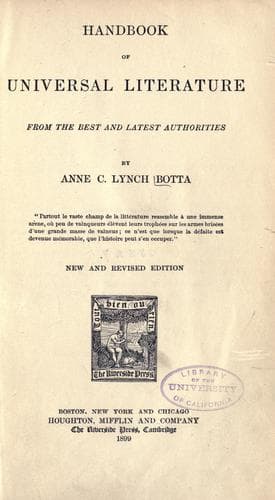
Handbook of Universal Literature, From the Best and Latest AuthoritiesBotta, Anne C. Lynch (Anne Charlotte Lynch)
History
Handbook of Universal Literature, From the Best and Latest Authorities
Botta, Anne C. Lynch (Anne Charlotte Lynch)
Literature -- History and criticism
Sophocles (495-406 B.C.), as a poet, is universally allowed to have
brought the drama to the highest degree of perfection of which it was
susceptible. Indeed, the Greek mind may be said to have culminated in him;
his writings overflow with that indescribable charm which only flashes
through those of other poets. His plots are worked up with more skill and
care than those of either of his great rivals, Aeschylus or Euripides, and
he added the last improvement to the form of the drama by the introduction
of a third actor,--a change which greatly enlarged the scope of the
action. Of the many tragedies which he is said to have written, only seven
are extant. Of these, the "Oedipus Tyrannus" is particularly remarkable
for its skillful development, and for the manner in which the interest of
the piece increases through each succeeding act. Of all the poets of
antiquity, Sophocles has penetrated most deeply into the recesses of the
human heart. His tragedies appear to us as pictures of the mind, as
poetical developments of the secrets of our souls, and of the laws to
which their nature makes them amenable.
In Euripides (480-407 B.C.) we discover the first traces of decline in the
Greek tragedy. He diminished its dignity by depriving it of its ideal
character, and by bringing it down to the level of every-day life. All the
characters of Euripides have that loquacity and dexterity in the use of
words which distinguished the Athenians of his day; yet in spite of all
these faults he has many beauties, and is particularly remarkable for
pathos, so that Aristotle calls him the most tragic of poets. Eighteen of
his tragedies are still extant.
The contemporaries of the three great tragic poets, Aeschylus, Sophocles,
and Euripides, must be regarded for the most part as far from
insignificant, since they maintained their place on the stage beside them,
and not unfrequently gained the tragic prize in competition with them; yet
the general character of these poets must have been deficient in that
depth and peculiar force of genius by which these great tragedians were
distinguished. If this had not been the case, their works would assuredly
have attracted greater attention, and would have been read mere frequently
in later times.
Public-domain text, read in full here on John Shaqi.
Reviews
Reviews
No reviews yet
Be the first to share your thoughts on this work.
Elsewhere in the archive
Join the Discussion
Join the discussion
Sign in to leave a comment or review.
Sign InorCreate an account