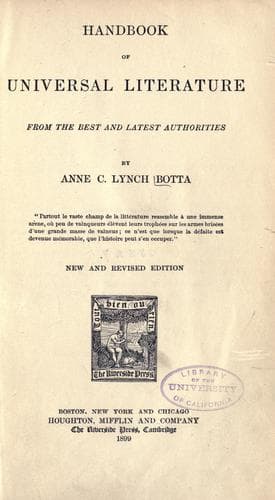
Handbook of Universal Literature, From the Best and Latest AuthoritiesBotta, Anne C. Lynch (Anne Charlotte Lynch)
History
Handbook of Universal Literature, From the Best and Latest Authorities
Botta, Anne C. Lynch (Anne Charlotte Lynch)
Literature -- History and criticism
The last poets of the Middle comedy were contemporaries of the writers of
the New, who rose up as their rivals, and who were only distinguished from
them by following the new tendency more decidedly and exclusively.
Menander (342-293 B.C.) was one of the first of these poets, and he is
also the most perfect of them. The Athens of his day differed from that of
the time of Pericles, in the same way that an old man, weak in body but
fond of life, good-humored and self-indulgent, differs from the vigorous,
middle-aged man at the summit of his mental strength and bodily energy.
Since there was so little in politics to interest or to employ the mind,
the Athenians found an object in the occurrences of social life and the
charm of dissolute enjoyment. Dramatic poetry now, for the first time,
centred in love, as it has since done among all nations to whom the Greek
cultivation has descended. But it certainly was not love in those nobler
forms to which it has since elevated itself. Menander painted truly the
degenerate world in which he lived, actuated by no mighty impulses, no
noble aspirations. He was contemporary with Epicurus, and their characters
had much in common; both were deficient in the inspiration of high moral
ideas.
The comedy of Menander and his contemporaries completed what Euripides had
begun on the tragic stage a hundred years before their time. They deprived
their characters of that ideal grandeur which had been most conspicuous in
the creations of Aeschylus and the earlier poets, and thus tragedy and
comedy, which had started from such different beginnings, here met as at
the same point. The comedies of Menander may be considered as almost the
conclusion of Attic literature; he was the last original poet of Athens;
those who arose at a later period were but gleaners after the rich harvest
of Greek poetry had been gathered.
Public-domain text, read in full here on John Shaqi.
Reviews
Reviews
No reviews yet
Be the first to share your thoughts on this work.
Elsewhere in the archive
Join the Discussion
Join the discussion
Sign in to leave a comment or review.
Sign InorCreate an account