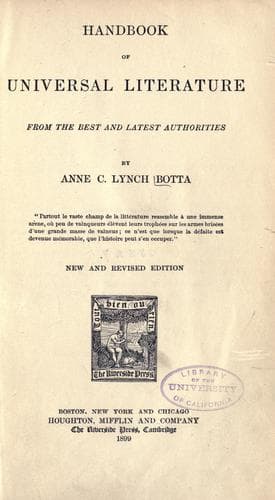
Handbook of Universal Literature, From the Best and Latest AuthoritiesBotta, Anne C. Lynch (Anne Charlotte Lynch)
History
Handbook of Universal Literature, From the Best and Latest Authorities
Botta, Anne C. Lynch (Anne Charlotte Lynch)
Literature -- History and criticism
6. ORATORY, RHETORIC, AND HISTORY.--We may distinguish three epochs in the
history of Attic prose from Pericles to Alexander the Great: first, that
of Pericles and Thucydides; second, that of Lysias, Socrates, and Plato;
and, third, that of Demosthenes and Aeschines. Public speaking had been
common in Greece from the earliest times, but as the works of Athenian
orators alone have come down to us, we may conclude that oratory was
cultivated in a much higher degree at Athens than elsewhere. No speech of
Pericles has been preserved in writing; only a few of his emphatic and
nervous expressions were kept in remembrance; but a general impression of
the grandeur of his oratory long prevailed among the Greeks, from which we
may form a clear conception of his style. The sole object of the oratory
of Pericles was to produce conviction; he did not aim to excite any sudden
or transient burst of passion by working on the emotions of the heart; nor
did he use any of those means employed by the orators of a later age to
set in motion the unruly impulses of the multitude. His manner was
tranquil, with hardly any change of feature; his garments were undisturbed
by any oratorical gesticulations, and his voice was equable and sustained.
He never condescended to flatter the people, and his dignity never stooped
to merriment. Although there was more of reasoning than imagination in his
speeches, he gave a vivid and impressive coloring to his language by the
use of striking metaphors and comparisons, as when, at the funeral of a
number of young persons who had fallen in battle, he used the beautiful
figure, that "the year had lost its spring."
Public-domain text, read in full here on John Shaqi.
Reviews
Reviews
No reviews yet
Be the first to share your thoughts on this work.
Elsewhere in the archive
Join the Discussion
Join the discussion
Sign in to leave a comment or review.
Sign InorCreate an account