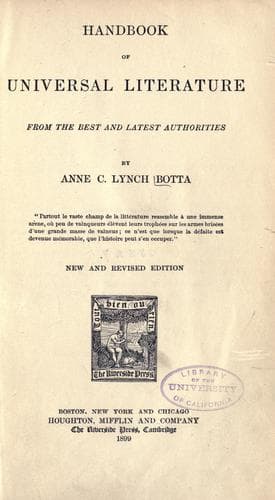
Handbook of Universal Literature, From the Best and Latest AuthoritiesBotta, Anne C. Lynch (Anne Charlotte Lynch)
History
Handbook of Universal Literature, From the Best and Latest Authorities
Botta, Anne C. Lynch (Anne Charlotte Lynch)
Literature -- History and criticism
Lysias and Isocrates gave an entirely new form to oratory by the happy
alterations which they in different ways introduced into the old prose
style. Lysias (fl. 359 B.C.), in the fiftieth year of his age, began to
follow the trade of writing speeches for such private individuals as could
not trust their own skill in addressing a court; for this object, a plain,
unartificial style was best suited, because citizens who called in the aid
of the speech-writer had no knowledge of rhetoric, and thus Lysias was
obliged to originate a style, which became more and more confirmed by
habit. The consequence was, that for his contemporaries and for all ages
he stands forth as the first and in many respects the perfect pattern of a
plain style. The narrative part of the speech, for which he was
particularly famous, is always natural, interesting, and lively, and often
relieved by mimic touches which give it a wonderful air of reality. The
proofs and confutations are distinguished by a clearness of reasoning and
a boldness of argument which leave no room for doubt; in a word, the
speeches are just what they ought to be in order to obtain a favorable
decision, an object in which, it seems, he often succeeded. Of his many
orations, thirty-five have come down to us.
Isocrates (fl. 338 B.C.) established a school for political oratory, which
became the first and most flourishing in Greece. His orations were mostly
destined for this school. Though neither a great statesman nor philosopher
in himself, Isocrates constitutes an epoch as a rhetorician or artist of
language. His influence extended far beyond the limits of his own school,
and without his reconstruction of the style of Attic oratory we could have
had no Demosthenes and no Cicero; through these, the school of Isocrates
has extended its influence even to the oratory of our own day.
Public-domain text, read in full here on John Shaqi.
Reviews
Reviews
No reviews yet
Be the first to share your thoughts on this work.
Elsewhere in the archive
Join the Discussion
Join the discussion
Sign in to leave a comment or review.
Sign InorCreate an account