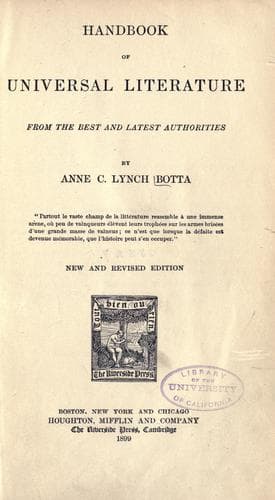
Handbook of Universal Literature, From the Best and Latest AuthoritiesBotta, Anne C. Lynch (Anne Charlotte Lynch)
History
Handbook of Universal Literature, From the Best and Latest Authorities
Botta, Anne C. Lynch (Anne Charlotte Lynch)
Literature -- History and criticism
The verdict of his contemporaries, ratified by posterity, has pronounced
Demosthenes (380-322 B.C.) the greatest orator that has ever lived, yet he
had no natural advantages for oratory. A feeble frame and a weak voice, a
shy and awkward manner, the ungraceful gesticulations of one whose limbs
had never been duly exercised, and a defective articulation, would have
deterred most men from even attempting to address an Athenian assembly;
but the ambition and perseverance of Demosthenes enabled him to triumph
over every disadvantage. He improved his bodily powers by running, his
voice by speaking aloud as he walked up hill, or declaimed against the
roar of the sea; he practiced graceful delivery before a looking-glass,
and controlled his unruly articulation by speaking with pebbles in his
mouth. His want of fluency he remedied by diligent composition, and by
copying and committing to memory the works of the best authors. By these
means he came forth as the acknowledged leader of the assembly, and, even
by the confession of his deadliest enemies, the first orator of Greece.
His harangues to the people, and his speeches on public and private
causes, which have been preserved, form a collection of sixty-one
orations. The most important efforts of Demosthenes, however, were the
series of public speeches referring to Philip of Macedon, and known as the
twelve Philippics, a name which has become a general designation for
spirited invectives. The main characteristic of his eloquence consisted in
the use of the common language of his age and country. He took great pains
in the choice and arrangement of his words, and aimed at the utmost
conciseness, making epithets, even common adjectives, do the work of a
whole sentence, and thus, by his perfect delivery and action, a sentence
composed of ordinary terms sometimes smote with the weight of a sledge-
hammer. In his orations there is not any long or close train of reasoning,
still less any profound observations or remote and ingenious allusions,
but a constant succession of remarks, bearing immediately on the matter in
hand, perfectly plain, and as readily admitted as easily understood. These
are intermingled with the most striking appeals either to feelings which
all were conscious of, and deeply agitated by, though ashamed to own, or
to sentiments which every man was panting to utter and delighted to hear
thundered forth,--bursts of oratory, which either overwhelmed or relieved
the audience. Such characteristics constituted the principal glory of the
great orator.
Public-domain text, read in full here on John Shaqi.
Reviews
Reviews
No reviews yet
Be the first to share your thoughts on this work.
Elsewhere in the archive
Join the Discussion
Join the discussion
Sign in to leave a comment or review.
Sign InorCreate an account