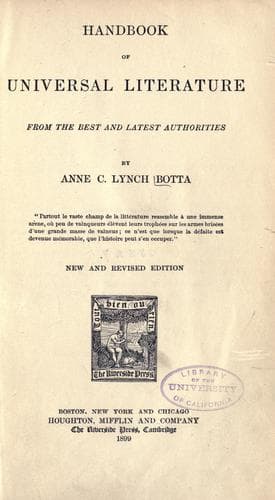
Handbook of Universal Literature, From the Best and Latest AuthoritiesBotta, Anne C. Lynch (Anne Charlotte Lynch)
History
Handbook of Universal Literature, From the Best and Latest Authorities
Botta, Anne C. Lynch (Anne Charlotte Lynch)
Literature -- History and criticism
7. SOCRATES AND THE SOCRATIC SCHOOLS.--Although Socrates (468-399 B.C.)
left no writings behind him, yet the intellect of Greece was powerfully
affected by the principles of his philosophy, and the greatest literary
genius that ever appeared in Hellas owed most of his mental training to
his early intercourse with him. It was by means of conversation, by a
searching process of question and answer, that Socrates endeavored to lead
his pupils to a consciousness of their own ignorance, and thus to awaken
in their minds an anxiety to obtain more exact views. This method of
questioning he reduced to a scientific process, and "dialectics" became a
name for the art of reasoning and the science of logic. The subject-matter
of this method was moral science considered with special reference to
politics. To him may be justly attributed induction and general
definitions, and he applied this practical logic to a common-sense
estimate of the duties of man both as a moral being and as a member of a
community, and thus he first treated moral philosophy according to
scientific principles. No less than ten schools of philosophers claimed
him as their head, though the majority of them imperfectly represented his
doctrines. By his influence on Plato, and through him on Aristotle, he
constituted himself the founder of the philosophy which is still
recognized in the civilized world.
From the doctrine held by Socrates, that virtue was dependent on
knowledge, Eucleides of Megara (fl. 398 B.C.), the founder of the Megaric
school, submitted moral philosophy to dialectical reasoning and logical
refinements; and from the Socratic principle of the union between virtue
and happiness, Aristippus of Cyrene (fl. 396 B.C.) deduced the doctrine
which became the characteristic of the Cyrenian school, affirming that
pleasure was the ultimate end of life and the higher good; while
Antisthenes (fl. 396 B.C.) constructed the Cynic philosophy, which placed
the ideal of virtue in the absence of every need, and hence in the
disregarding of every interest, wealth, honor, and enjoyment, and in the
independence of any restraints of life and society. Diogenes of Sinope
(fl. 300 B.C.) was one of the most prominent followers of this school. He,
like his master, Antisthenes, always appeared in the most beggarly
clothing, with the staff and wallet of mendicancy; and this ostentation of
self-denial drew from Socrates the exclamation, that he saw the vanity of
Antisthenes through the holes in his garments.
Public-domain text, read in full here on John Shaqi.
Reviews
Reviews
No reviews yet
Be the first to share your thoughts on this work.
Elsewhere in the archive
Join the Discussion
Join the discussion
Sign in to leave a comment or review.
Sign InorCreate an account