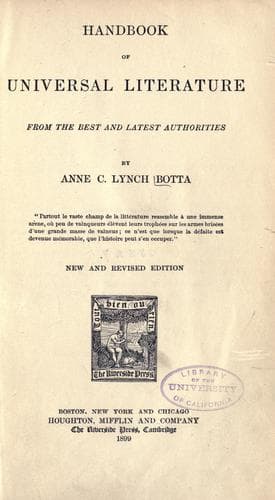
Handbook of Universal Literature, From the Best and Latest AuthoritiesBotta, Anne C. Lynch (Anne Charlotte Lynch)
History
Handbook of Universal Literature, From the Best and Latest Authorities
Botta, Anne C. Lynch (Anne Charlotte Lynch)
Literature -- History and criticism
Plato (429-348 B.C.) was the only--one of the disciples of Socrates who
represented the whole doctrines of his teacher. We owe to him that the
ideas which Socrates awakened have been made the germ of one of the
grandest systems of speculation that the world has ever seen, and that it
has been conveyed to us in literary compositions which are unequaled in
refinement of conception, or in vigor and gracefulness of style. At the
age of nineteen he became one of the pupils and associates of Socrates,
and did not leave him until that martyr of intellectual freedom drank the
fatal cup of hemlock. He afterwards traveled in Asia Minor, in Egypt, in
Italy, and Sicily, and made himself acquainted with all contemporary
philosophy. During the latter part of his life he was engaged as a public
lecturer on philosophy. His lectures were delivered in the gardens of the
Academia, and they have left proof of their celebrity in the structure of
language, which has derived from them a term now common to all places of
instruction. Of the importance of the Socratic and Pythagorean elements in
Plato's philosophy there can be no doubt; but he transmuted all he touched
into his own forms of thought and language, and there was no branch of
speculative literature which he had not mastered. By adopting the form of
dialogue, in which all his extant works have come down to us, he was
enabled to criticise the various systems of philosophy then current in
Greece, and also to gratify his own dramatic genius, and his almost
unrivaled power of keeping up an assumed character. The works of Plato
have been divided into three classes: first, the elementary dialogues, or
those which contain the germs of all that follows, of logic as the
instrument of philosophy, and of ideas as its proper object; second,
progressive dialogues, which treat of the distinction between
philosophical and common knowledge, in their united application to the
proposed and real sciences, ethics, and physics; third, the constructive
dialogues, in which the practical is completely united with the
speculative, with an appendix containing laws, epistles, etc.
Public-domain text, read in full here on John Shaqi.
Reviews
Reviews
No reviews yet
Be the first to share your thoughts on this work.
Elsewhere in the archive
Join the Discussion
Join the discussion
Sign in to leave a comment or review.
Sign InorCreate an account