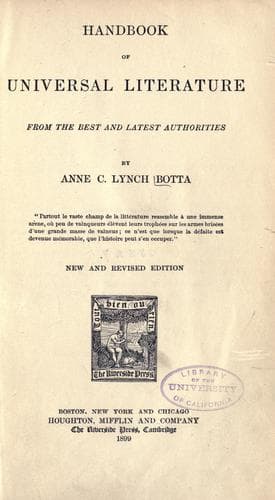
Handbook of Universal Literature, From the Best and Latest AuthoritiesBotta, Anne C. Lynch (Anne Charlotte Lynch)
History
Handbook of Universal Literature, From the Best and Latest Authorities
Botta, Anne C. Lynch (Anne Charlotte Lynch)
Literature -- History and criticism
calculations.
4. ALEXANDRIAN PHILOSOPHY.--Athens, which had been the centre of Greek
literature during the second or classical period of its development, had
now, in all respects but one, resigned the intellectual leadership to the
city of the Ptolemies. While Alexandria was producing a series of learned
poets, scholars, and discoverers in science, Athenian literature was
mainly represented by the establishment of certain forms of mental and
moral philosophy founded on the various Socratic schools. Two schools of
philosophy were established at Athens at the time of the death of
Aristotle: that of the Academy, in which he himself had studied, and that
of the Lyceum, which he had founded, as the seat of his peripatetic
system. But the older schools soon reappeared under new names: the
Megarics, with an infusion of the doctrines of Democritus, revived in the
skeptic philosophy of Pyrrhon (375-285 B.C.). Epicurus (342-370 B.C.)
founded the school to which he gave his name, by a similar combination of
Democritean philosophy with the doctrines of the Cyrenaics; the Cynics
were developed into Stoics by Zeno (341-260 B.C.), who borrowed much from
the Megaric school and from the Old Academy; and, finally, the Middle and
New Academy arose from a combination of doctrines which were peculiar to
many of these sects.
Though these different schools, which flourished at Athens, had early
representatives in Alexandria, their different doctrines, coming in
contact with the ancient religious systems of the Persians, Jews, and
Hindus, underwent essential modifications, and gave birth to a kind of
electicism, which became later an important element in the development of
Christian history. The rationalism of the Platonic school and the
supernaturalism of the Jewish Scriptures were chiefly mingled together,
and from this amalgamation sprang the system of Neo-Platonism. When the
early teachers of Christianity at Alexandria strove to show the harmony of
the Gospel with the great principles of the Greco-Jewish philosophy, it
underwent new modifications, and the Neo-Platonic school, which sprang up
in Alexandria three centuries B.C., was completed in the first and second
centuries of the Christian era. The common characteristic of the Neo-
Platonists was a tendency to mysticism. Some of them believed that they
were the subjects of divine inspiration and illumination; able to look
into the future and to work miracles. Philo-Judaeus (fl. 20 B.C.),
Numenius (fl. 150 A.D.), Ammonius Saccas (fl. 200 A.D.), Plotinus (fl, 260
A.D.), Porphyry (fl. 260 A.D.), and several fathers of the Greek Church
are among the principal disciples of this school.
Public-domain text, read in full here on John Shaqi.
Reviews
Reviews
No reviews yet
Be the first to share your thoughts on this work.
Elsewhere in the archive
Join the Discussion
Join the discussion
Sign in to leave a comment or review.
Sign InorCreate an account