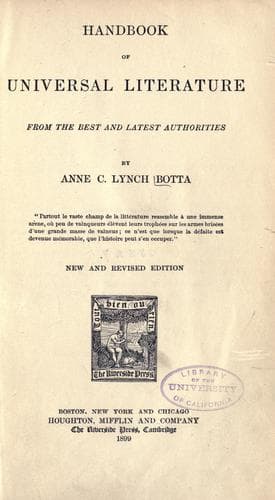
Handbook of Universal Literature, From the Best and Latest AuthoritiesBotta, Anne C. Lynch (Anne Charlotte Lynch)
History
Handbook of Universal Literature, From the Best and Latest Authorities
Botta, Anne C. Lynch (Anne Charlotte Lynch)
Literature -- History and criticism
In the historical department may be mentioned Ptolemy Soter, who wrote the
history of the wars of Alexander the Great; Apollodorus (fl. 200 B.C.),
whose "Bibliotheca" contains a general sketch of the mystic legends of the
Greeks; Eratosthenes (fl. 235 B.C.), the founder of scientific chronology
in Greek history; Manetho (fl. 280 B.C.), who introduced the Greeks to a
knowledge of the Egyptian religion and annals; and Berosus of Babylon, his
contemporary, whose work, fragments of which were preserved by Josephus,
was known as the "Babylonian Annals." While the Greeks of Alexandria thus
gained a knowledge of the religious books of the nations conquered by
Alexander, the same curiosity, combined with the necessities of the Jews
of Alexandria, gave birth to the translation of the Bible into Greek,
known under the name of Septuagint, which has exercised a more lasting
influence on the civilized world than that of any book that has ever
appeared in a new tongue. The beginning of that translation was probably
made in the reigns of the first Ptolemies (320-249 B.C.), while the
remainder was completed at a later period.
The wonderful advance, which took place in pure and applied mathematics,
is chiefly due to the learned men who settled in Alexandria; the greatest
mathematicians and the most eminent founders of scientific geography were
all either immediately or indirectly connected with the school of
Alexandria. Euclid (fl. 300 B.C.) founded a famous school of geometry in
that city, in the reign of the first Ptolemy. Almost the only incident of
his life which is known to us is a conversation between him and that king,
who, having asked if there was no easier method of learning the science,
is said to have been told by Euclid, that "there was no royal path to
geometry." His most famous work is his "Elements of Pure Mathematics," at
the present time a manual of instruction and the foundation of all
geometrical treatises. Archimedes (287-212 B.C.) was a native of Syracuse,
in Sicily, but he traveled to Egypt at an early age, and studied
mathematics there in the school of Euclid. He not only distinguished
himself as a pure mathematician and astronomer, and as the founder of the
theory of statics, but he discovered the law of specific gravity, and
constructed some of the most useful machines in the mechanic arts, such as
the pulley and the hydraulic screw. His works are written in the Doric
dialect. Apollonius of Perga (221-204 B.C.) distinguished himself in the
mathematical department by his work on "Conic Elements." Eratosthenes was
not only prominent in the science of chronology, but was also the founder
of astronomical geography, and the author of many valuable works in
various branches of philosophy. Hipparchus (fl. 150 B.C.) is considered
the founder of the science of exact astronomy, from his great work, the
"Catalogue of the Fixed Stars," his discovery of the precession of the
equinoxes, and many other valuable astronomical observations and
Public-domain text, read in full here on John Shaqi.
Reviews
Reviews
No reviews yet
Be the first to share your thoughts on this work.
Elsewhere in the archive
Join the Discussion
Join the discussion
Sign in to leave a comment or review.
Sign InorCreate an account