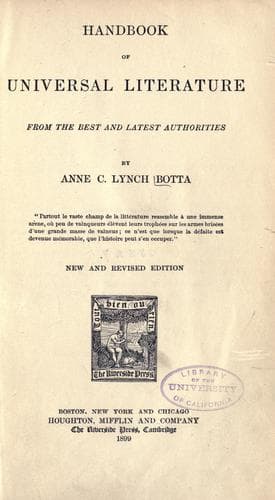
Handbook of Universal Literature, From the Best and Latest AuthoritiesBotta, Anne C. Lynch (Anne Charlotte Lynch)
History
Handbook of Universal Literature, From the Best and Latest Authorities
Botta, Anne C. Lynch (Anne Charlotte Lynch)
Literature -- History and criticism
6. GREEK LITERATURE IN ROME.--After the subjugation of Greece by the
Romans, Greek authors wrote in their own language and published their
works in Rome; illustrious Romans chose the idiom of Plato as the best
medium for the expression of their own thoughts; dramatic poets gained a
reputation by imitating the tragedies and comedies of Athens, and every
versifier felt compelled by fashion to revive the metres of ancient
Greece. This naturalization of Greek literature at Rome was due to the
rudeness and poverty of the national literature of Italy, to the influence
exerted by the Greek colonies, and to the political subjugation of Greece.
In Rome, Greek libraries were established by the Emperor Augustus and his
successors; and the knowledge of the Greek language was considered a
necessary accomplishment. Cicero made his countrymen acquainted with the
philosophical schools of Athens, and Rome became more and more the rival
of Alexandria, both as a receptacle for the best Greek writings and as a
seat of learning, where Greek authors found appreciation and patronage.
The Greek poets, who were fostered and encouraged at Rome, were chiefly
writers of epigrams, and their poems are preserved in the collections
called "Anthologies." The growing demand for forensic eloquence naturally
led the Roman orators to find their examples in those of Athens, and to
the study of rhetoric in the Grecian writers.
Among the writers on rhetoric whose works seem to have produced the,
greatest effect at the beginning of the Roman period, we mention Dionysius
of Halicarnassus (fl. 7 B.C.). As a critic, he occupies the first rank
among the ancients. Besides his rhetorical treatises, he wrote a work on
"Roman Archaeology," the object of which was to show that the Romans were
not, after all, barbarians, as was generally supposed, but a pure Greek
race, whose institutions, religion, and manners were traceable to an
identity with those of the noblest Hellenes.
What Dionysius endeavored to do for the gratification of his own
countrymen, by giving them a Greek version of Roman history, an
accomplished Jew, who lived about a century later, attempted, from the
opposite point of view, for his own fallen race, in a work which was a
direct imitation of that just described. Flavius Josephus (fl. 60 A.D.)
wrote the "Jewish Archaeology" in order to show the Roman conquerors of
Jerusalem that the Jews did not deserve the contempt with which they were
universally regarded. His "History of the Jewish Wars" is an able and
valuable work.
Public-domain text, read in full here on John Shaqi.
Reviews
Reviews
No reviews yet
Be the first to share your thoughts on this work.
Elsewhere in the archive
Join the Discussion
Join the discussion
Sign in to leave a comment or review.
Sign InorCreate an account