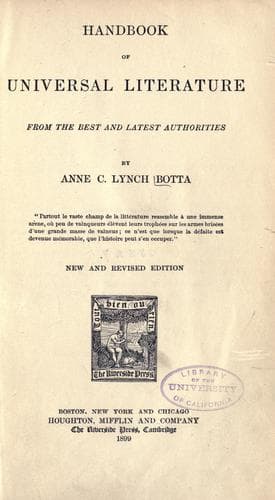
Handbook of Universal Literature, From the Best and Latest AuthoritiesBotta, Anne C. Lynch (Anne Charlotte Lynch)
History
Handbook of Universal Literature, From the Best and Latest Authorities
Botta, Anne C. Lynch (Anne Charlotte Lynch)
Literature -- History and criticism
At an earlier period, Polybius (204-122 B.C.) wrote to explain to the
Greeks how the power of the Romans had established itself in Greece. His
great work was a universal history, but of the forty books of which it
consisted only five have been preserved; perhaps no historical work has
ever been written with such definiteness of purpose or unity of plan, or
with such self-consciousness on the part of the writer. The object to
which he directs attention is the manner in which fortune or providence
uses the ability and energy of man as instruments in carrying out what is
predetermined, and specially the exemplification of these principles in
the wonderful growth of the Roman power during the fifty-three years of
which he treats. Taking his history as a whole, it is hardly possible to
speak in too high terms of it, though the style has many blemishes, such
as endless digressions, wearisome repetition of his own principles and
colloquial vulgarisms.
Diodorus, a native of Sicily, generally known as the Sicilian (Siculus),
flourished in the time of the first two Caesars. In his great work, the
"Historical Library," it was his object to write a history of the world
down to the commencement of Caesar's Gallic wars. He is content to give a
bare recital of the facts, which crowded upon him and left him no time to
be diffuse or ornamental.
The geography of Strabo (fl. 10 A.D.), which has made his name familiar to
modern scholars, has come down to us very nearly complete. Its merits are
literary rather than scientific. His object was to give an instructive and
readable account of the known world, from the point of view taken by a
Greek man of letters. His style is simple, unadorned, and unaffected.
Plutarch (40-120 A.D.) may be classed among the philosophers as well as
among the historians. Though he has left many essays and works on
different subjects, he is best known as a biographer. His lives of
celebrated Greeks and Romans have made his name familiar to the readers of
every country. The universal popularity of his biographies is due to the
fact that they are dramatic pictures, in which each personage is
represented as acting according to his leading characteristics.
Pausanias (fl. 184 A.D.), a professed describer of countries and of their
antiquities and works of art, in his "Gazetteer of Hellas" has left the
best repertory of information for the topography, local history, religious
observances, architecture, and sculpture of the different states of
Greece.
Public-domain text, read in full here on John Shaqi.
Reviews
Reviews
No reviews yet
Be the first to share your thoughts on this work.
Elsewhere in the archive
Join the Discussion
Join the discussion
Sign in to leave a comment or review.
Sign InorCreate an account