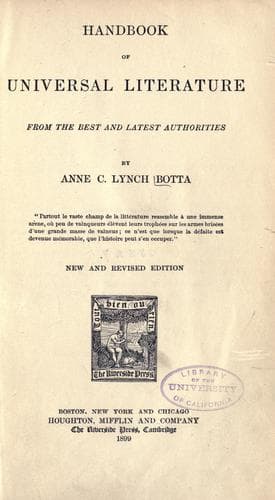
Handbook of Universal Literature, From the Best and Latest AuthoritiesBotta, Anne C. Lynch (Anne Charlotte Lynch)
History
Handbook of Universal Literature, From the Best and Latest Authorities
Botta, Anne C. Lynch (Anne Charlotte Lynch)
Literature -- History and criticism
After the fall of Constantinople, the Greeks were prominent in spreading a
knowledge of their language through Europe, and but few works of
importance were produced. During the eighteenth century a revival of
enthusiasm for education and literature took place, and a period of great
literary activity has since followed. Perhaps no nation now produces so
much literature in proportion to its numbers, although the number of
readers is small and there are great difficulties in publishing. In these
circumstances, the Ralli and other distinguished Greeks have nobly come
forward and published books at their own expense, and great activity
prevails in every department of letters.
Since the establishment of Greek independence, three writers have secured
for themselves a permanent place in literature as men of true genius: the
two brothers Panagiotis and Alexander Santsos, and Alexander Rangabé. The
brothers Santsos threw all their energies into the war for independence
and sang of its glories. Panagiotis (d. 1868) was always lyrical, and
Alexander (d. 1863) always satirical. Both were highly ideal in their
conceptions, and both had a rich command of musical language. The other
great poet of regenerated Greece is Alexander Rangabé, whose works range
through almost every department of literature, though it is on his poems
that his claim to remembrance will specially rest. They are distinguished
by fine poetic feeling, rare command of exquisite and harmonious language,
and singular beauty and purity of thought. His poetical works consist of
hymns, odes, songs, narrative poems, ballads, tragedies, comedies, and
translations. There is no department in prose literature which is not well
represented in modern Greek, and many women have particularly
distinguished themselves.
ROMAN LITERATURE.
INTRODUCTION.--1. Roman Literature and its Divisions.--2. The Language;
Ethnographical Elements of the Latin Language; the Umbrian; Oscan;
Etruscan; the Old Roman Tongue; Saturnian Verse; Peculiarities of the
Latin Language.--3. The Roman Religion.
PERIOD FIRST.--1. Early Literature of the Romans; the Fescennine Songs;
the Fabulae Atellanae.--2. Early Latin Poets; Livius Andronicus, Naevius,
and Ennius.--3. Roman Comedy.--4. Comic Poets; Plautus, Terence, and
Statius.--5. Roman Tragedy.--6. Tragic Poets; Pacuvius and Attius.--7.
Satire; Lucilius.--8. History and Oratory; Fabius Pictor; Cencius
Alimentus; Cato; Varro; M. Antonius; Crassus; Hortensius.--9. Roman
Jurisprudence.--10. Grammarians.
PERIOD SECOND.--1. Development of the Roman Literature.--2. Mimes,
Mimographers, Pantomime; Laberius and P. Lyrus.--3. Epic Poetry; Virgil;
The Aeneid.--4. Didactic Poetry; the Bucolics; the Georgics; Lucretius.--
5. Lyric Poetry; Catullus; Horace.--6. Elegy; Tibullus; Propertius; Ovid.
--7. Oratory and Philosophy; Cicero.--8. History; J. Caesar; Sallust;
Livy.--9. Other Prose Writers.
Public-domain text, read in full here on John Shaqi.
Reviews
Reviews
No reviews yet
Be the first to share your thoughts on this work.
Elsewhere in the archive
Join the Discussion
Join the discussion
Sign in to leave a comment or review.
Sign InorCreate an account