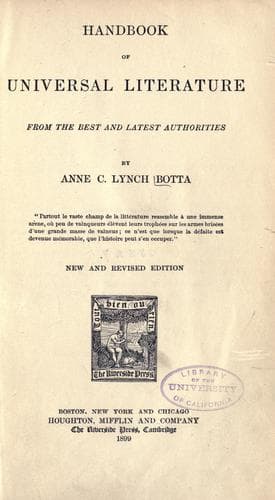
Handbook of Universal Literature, From the Best and Latest AuthoritiesBotta, Anne C. Lynch (Anne Charlotte Lynch)
History
Handbook of Universal Literature, From the Best and Latest Authorities
Botta, Anne C. Lynch (Anne Charlotte Lynch)
Literature -- History and criticism
The writings of the Apostolic Fathers, or the immediate successors of the
Apostles, were held in high estimation by the primitive Christians. Of
those who wrote under this denomination, the venerable Polycarp and
Ignatius, after they had both attained the age of eighty years, sealed
their faith in the blood of martyrdom. The former was burned at the stake
in Smyrna, and the latter devoured by lions in the amphitheatre of Rome,
In the second and third centuries, Christianity numbered among its
advocates many distinguished scholars and philosophers, particularly among
the Greeks. Their productions may be classed under the heads of biblical,
controversial, doctrinal, historical, and homiletical. Among the most
distinguished of the Greek fathers were Justin Martyr (fl. 89 A.D.), an
eminent Christian philosopher and speculative thinker; Clement of
Alexandria (fl. 190 A.D.), who has left us a collection of works, which,
for learning and literary talent, stand unrivaled among the writings of
the early Christian fathers; Origen (184-253 A.D.), who, in his numerous
works, attempted to reconcile philosophy with Christianity; Eusebius (fl.
325 A.D.), whose ecclesiastical history is ranked among the most valuable
remains of Christian antiquity; Athanasius, famous for his controversy
with Arius; Gregory Nazianzen (329-390 A.D.), distinguished for his rare
union of eloquence and piety, a great orator and theologian; Basil (329-
379 A.D.) whose works, mostly of a purely theological character, exhibit
occasionally decided proofs of his strong feeling for the beauties of
nature; and John Chrysostom (347-407 A.D.), the founder of the art of
preaching, whose extant homilies breathe a spirit of sincere earnestness
and of true genius. To these may be added Nemesius (fl. 400 A.D.), whose
work on the "Nature of Man" is distinguished by the purity of its style
and by the traces of a careful study of classical authors, and Synesius
(378-430 A.D.), who maintained the parallel importance of pagan and
Christian literature, and who has always been held in high estimation for
his epistles, hymns, and dramas.
MODERN LITERATURE.
At the time of the fall of Constantinople, ancient Greek was still the
vehicle of literature, and as such it has been preserved to our day. After
the political changes of the present century, however, it was felt by the
best Greek writers that the old forms were no longer fitted to express
modern ideas, and hence it has become transfused with those better adapted
to the clear and rapid expression of modern literature, though at the same
time the body and substance, as well as the grammar, of the language have
been retained.
From an early age, along with the literary language of Greece, there
existed a conversational language, which varied in different localities,
and out of this grew the Modern Greek or Neo-Hellenic.
Public-domain text, read in full here on John Shaqi.
Reviews
Reviews
No reviews yet
Be the first to share your thoughts on this work.
Elsewhere in the archive
Join the Discussion
Join the discussion
Sign in to leave a comment or review.
Sign InorCreate an account