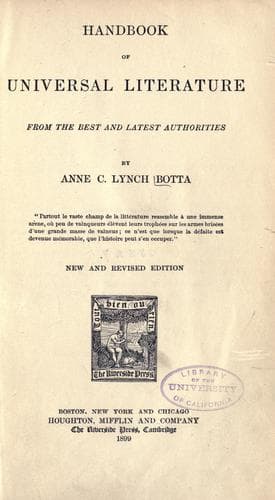
Handbook of Universal Literature, From the Best and Latest AuthoritiesBotta, Anne C. Lynch (Anne Charlotte Lynch)
History
Handbook of Universal Literature, From the Best and Latest Authorities
Botta, Anne C. Lynch (Anne Charlotte Lynch)
Literature -- History and criticism
The Etruscan tongue being a compound of Pelasgian and Umbrian, the
language of Latium may be considered as the result of those two elements
combined with the Oscan, and brought together by the mingling of those
different tribes. These elements, which entered into the formation of the
Latin, may be classified under two heads: the one which has, the other
which has not a resemblance to the Greek. All Latin words which resemble
the Greek are Pelasgian, and all which do not are Etruscan, Oscan, or
Umbrian. From the first of these classes must be excepted those words
which are directly derived from the Greek, the origin of which dates
partly from the time when Rome began to have intercourse with the Greek
colonies of Magna Graecia, partly after the Greeks exercised a direct
influence on Roman literature.
Of the ancient languages of Italy, which concurred in the formation of the
Latin, little is known. The Eugubine Tables are the only extant fragments
of the Umbrian language. These were found in the neighborhood of Ugubio,
in the year 1414 A.D.; they date as early as 354 B.C., and contain prayers
and rules for religious ceremonies. Some of these tables were engraved in
Etruscan or Umbrian characters, others in Latin letters. The remains which
have come down to us of the Oscan language belong to a composite idiom
made up of the Sabine and Oscan, and consist chiefly of an inscription
engraved on a brass plate, discovered in 1793 A.D. As the word Bansae
occurs in this inscription, it has been supposed to refer to the town of
Bantia, which was situated not far from the spot where the tablet was
found, and it is, therefore, called the Bantine Table. The similarity
between some of the words found in the Eugubine Tables and in Etruscan
inscriptions, shows that the Etruscan language was composed of the
Pelasgian and Umbrian, and from the examples given by ethnographers, it is
evident that the Etruscan element was most influential in the formation of
the Latin language.
The old Roman tongue, or _lingua prisca_, as it was composed of these
materials, and as it existed previous to coming in contact with the Greek,
has almost entirely perished; it did not grow into the new, like the
Greek, by a process of intrinsic development, but it was remoulded by
external and foreign influences. So different was the old Roman from the
classical Latin, that some of those ancient fragments were with difficulty
intelligible to the cleverest and best educated scholars of the Augustan
age.
Public-domain text, read in full here on John Shaqi.
Reviews
Reviews
No reviews yet
Be the first to share your thoughts on this work.
Elsewhere in the archive
Join the Discussion
Join the discussion
Sign in to leave a comment or review.
Sign InorCreate an account