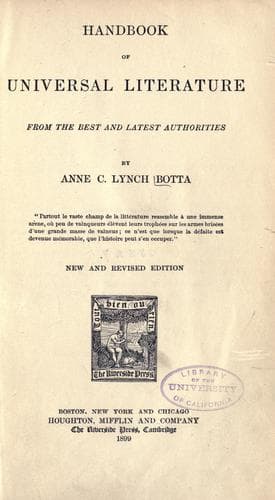
Handbook of Universal Literature, From the Best and Latest AuthoritiesBotta, Anne C. Lynch (Anne Charlotte Lynch)
History
Handbook of Universal Literature, From the Best and Latest Authorities
Botta, Anne C. Lynch (Anne Charlotte Lynch)
Literature -- History and criticism
An example of the oldest Latin extant is contained in the sacred chant of
the Fratres Arvales. These were a college of priests, whose function was
to offer prayers for plenteous harvests, in solemn dances and processions
at the opening of spring. Their song was chanted in the temple with closed
doors, accompanied by that peculiar dance which was termed the tripudium,
from its containing three beats. The inscription which embodied this
litany was discovered in Rome in 1778 A.D. The monument belongs to the
reign of Heliogabalus, 218 A.D., but although the date is so recent, the
permanence of religious formulas renders it probable that the inscription
contains the exact words sung by this priesthood in the earliest times.
The "Carmen Saliare," or the Salian hymn, the _leges regiae_, the
Tiburtine inscription, the inscription on the sarcophagus of L. Cornelius
Scipio Barbatus, the great-grandfather of the conqueror of Hannibal, the
epitaph of Lucius Scipio, his son, and, above all, the Twelve Tables, are
the other principal extant monuments of ancient Latin. The laws of the
Twelve Tables were engraven on tablets of brass, and publicly set up in
the comitium; they were first made public 449 B.C.
Most of these literary monuments were written in Saturnian verse, the
oldest measure used by the Latin poets. It was probably derived from the
Etruscans, and until Ennius introduced the heroic hexameter, the strains
of the Italian bards flowed in this metre. The structure of the Saturnian
is very simple, and its rhythmical arrangement is found in the poetry of
every age and country. Macaulay adduces, as an example of this measure,
the following line from the well-known nursery song,----
"The queén was ín her párlor, | eáting breád and hóney."
From this species of verse, which probably prevailed among the natives of
Provence (the Roman Provincia), and into which, at a later period, rhyme
was introduced as an embellishment, the Troubadours derived the metre of
their ballad poetry, and thence introduced it into the rest of Europe.
Public-domain text, read in full here on John Shaqi.
Reviews
Reviews
No reviews yet
Be the first to share your thoughts on this work.
Elsewhere in the archive
Join the Discussion
Join the discussion
Sign in to leave a comment or review.
Sign InorCreate an account