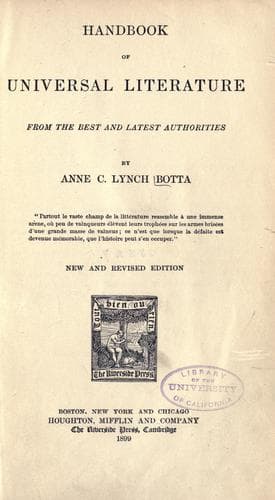
Handbook of Universal Literature, From the Best and Latest AuthoritiesBotta, Anne C. Lynch (Anne Charlotte Lynch)
History
Handbook of Universal Literature, From the Best and Latest Authorities
Botta, Anne C. Lynch (Anne Charlotte Lynch)
Literature -- History and criticism
Naevius, the last of the older school of writers, by introducing new
principles of taste to his countrymen, altered their standards; and Greek
literature having now driven out its predecessor, a new school of poetry
arose, of which Ennius (239-169 B.C.) was the founder. He earned a
subsistence as a teacher of Greek, was the friend of Scipio, and, at his
death, was buried in the family tomb of the Scipio, at the request of the
great conqueror of Hannibal, whose fame he contributed to hand down to
posterity. Cicero always uses the appellation, "our own Ennius," when he
quotes his poetry. Horace calls him "Father Ennius," a term which implies
reverence and regard, and that he was the founder of Latin poetry. He was,
like his friends Cato the censor, and Scipio Africanus the elder, a man of
action as well as philosophical thought, and not only a poet, but a brave
soldier, with all the singleness of heart and simplicity of manners which
marked the old times of Roman virtue. Ennius possessed great power over
words, and wielded that power skillfully. He improved the language in its
harmony and its grammatical forms, and increased its copiousness and
power. What he did was improved upon, but was never undone; and upon the
foundations he laid, the taste of succeeding ages erected an elegant and
beautiful superstructure. His great epic poem, the "Annals," gained him
the attachment and admiration of his countrymen. In this he first
introduced the hexameter to the notice of the Romans, and detailed the
rise and progress of their national glory, from the earliest legendary
period down to his own times. The fragments of this work which remain are
amply sufficient to show that he possessed picturesque power, both in
sketching his narratives and in portraying his characters, which seem to
live and breathe; his language, dignified, chaste, and severe, rises as
high as the most majestic eloquence, but it does not soar to the sublimity
of poetry. As a dramatic poet, Ennius does not deserve a high reputation.
In comedy, as in tragedy, he never emancipated himself from the Greek
originals.
Public-domain text, read in full here on John Shaqi.
Reviews
Reviews
No reviews yet
Be the first to share your thoughts on this work.
Elsewhere in the archive
Join the Discussion
Join the discussion
Sign in to leave a comment or review.
Sign InorCreate an account