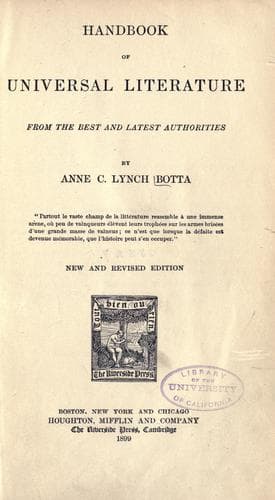
Handbook of Universal Literature, From the Best and Latest AuthoritiesBotta, Anne C. Lynch (Anne Charlotte Lynch)
History
Handbook of Universal Literature, From the Best and Latest Authorities
Botta, Anne C. Lynch (Anne Charlotte Lynch)
Literature -- History and criticism
2. EARLY LATIN POETS.--At the conclusion, of the first Punic war, when the
influence of Greek intellect, which had already long been felt in Italy,
had extended to the capital, the Romans were prepared for the reception of
a more regular drama. But not only did they owe to Greece the principles
of literary taste; their earliest poet was one of that nation. Livius
Andronicus (fl. 240 B.C.), though born in Italy, and educated at Rome, is
supposed to have been a native of the Greek colony of Tarentum. He was at
first a slave, probably a captive taken in war, but was finally
emancipated by his master, in whose family he occupied the position of
instructor to his children. He wrote a translation, or perhaps an
imitation of the Odyssey, in the old Saturnian metre, and also a few
hymns. His principal works, however, were tragedies; but, from the few
fragments of his writings extant, it is impossible to form an estimate of
his ability as a poet. According to Livy, Andronicus was the first who
substituted, for the rude extemporaneous effusions of the Fescennine
verse, plays with a regular plot and fable. In consequence of losing his
voice, from being frequently encored, he obtained permission to introduce
a boy to sing the ode or air to the accompaniment of the flute, while he
himself represented the action of the song by his gestures and dancing.
Naevius (fl. 235 B.C.) was the first poet who really deserves the name of
Roman. He was not a servile imitator, but applied Greek taste and
cultivation to the development of Roman sentiments, and was a true Roman
in heart, unsparing in his censure of immorality and his admiration for
heroic self-devotion. His honest principles cemented the strong friendship
between him and the upright and unbending Cato, a friendship which
probably contributed to form the political and literary character of that
stern old Roman. The comedies of Naevius had undoubted pretensions to
originality; he held up to public scorn the vices and follies of his day,
and, being a warm supporter of the people against the encroachments of the
nobility, and unable to resist indulgence in his satiric vein, he was
exiled to Utica, where he died. He was the author of an epic poem on the
Punic war. Ennius and Virgil unscrupulously copied and imitated him, and
Horace writes that in his day the poems of Naevius were in the hands and
hearts of everybody. The fragments of his writings extant are not more
numerous than those of Livius.
Public-domain text, read in full here on John Shaqi.
Reviews
Reviews
No reviews yet
Be the first to share your thoughts on this work.
Elsewhere in the archive
Join the Discussion
Join the discussion
Sign in to leave a comment or review.
Sign InorCreate an account