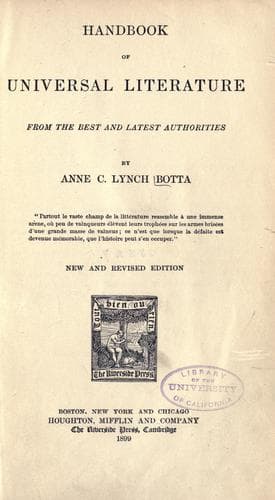
Handbook of Universal Literature, From the Best and Latest AuthoritiesBotta, Anne C. Lynch (Anne Charlotte Lynch)
History
Handbook of Universal Literature, From the Best and Latest Authorities
Botta, Anne C. Lynch (Anne Charlotte Lynch)
Literature -- History and criticism
the theatre was merely a place for secular amusement, and poetry only an
exercise of the fancy. Again, the religion of the Romans was not ideal,
like that of the Greeks. The old national faith of Italy, not being rooted
in the heart, soon became obsolete, and readily admitted the ingrafting of
foreign superstitions, which had no hold on the belief or love of the
people. Nor was the genius of the Roman people such as to sympathize with
the legends of the past; they lived only in the present and the future;
they did not look back on their national heroes as demigods; they were
pressing forward to extend the frontiers of their empire, to bring under
their yoke nations which their forefathers had not known. If they regarded
their ancestors at all, it was not in the light of men of heroic stature
as compared with themselves, but as those whom they could equal or even
surpass.
The scenes of real life, the bloody combats of the gladiators, the
captives, and malefactors stretched on crosses, expiring in excruciating
agonies or mangled by wild beasts, were the tragedies which most deeply
interested a Roman audience.
The Romans were a rough people, full of physical rather than of
intellectual energy, courting peril and setting no value on human life or
suffering. Their very virtues were stern and severe; they were strangers
to both the passions which it was the object of tragedy to excite--pity
and terror. In the public games of Greece, the refinements of poetry
mingled with those exercises which were calculated to invigorate the
physical powers, and develop manly beauty. Those of Rome were sanguinary
and brutalizing, the amusements of a nation to whom war was a pleasure and
a pastime.
It cannot be asserted, however, that tragedy was never to a certain extent
an acceptable entertainment at Rome, but only that it never flourished
there as it did at Athens, and that no Roman tragedies can be compared
with those of Greece.
6. TRAGIC POETS.--Three separate eras produced tragic poets. In the first
flourished Livius Andronicus, Naevius, and Ennius; in the second, Pacuvius
and Attius; in the third, Asinius Pollio wrote tragedies, the plots of
which seem to have been taken from Roman history. Ovid attempted a
"Medea," and even the Emperor Augustus, with other men of genius, tried
his hand, though unsuccessfully, at tragedy.
Public-domain text, read in full here on John Shaqi.
Reviews
Reviews
No reviews yet
Be the first to share your thoughts on this work.
Elsewhere in the archive
Join the Discussion
Join the discussion
Sign in to leave a comment or review.
Sign InorCreate an account