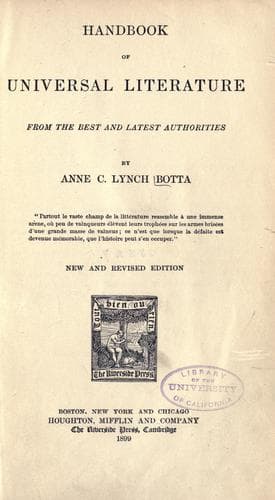
Handbook of Universal Literature, From the Best and Latest AuthoritiesBotta, Anne C. Lynch (Anne Charlotte Lynch)
History
Handbook of Universal Literature, From the Best and Latest Authorities
Botta, Anne C. Lynch (Anne Charlotte Lynch)
Literature -- History and criticism
In the second of the eras mentioned, Roman tragedy reached its highest
degree of perfection simultaneously with that of comedy. While Terence was
successfully reproducing the wit and manners of the new Attic comedy,
Pacuvius (220-130 B.C.) was enriching the Roman drama with free
translations of the Greek tragedians. He was a native of Brundusium and a
grandson of the poet Ennius. At Rome he distinguished himself as a painter
as well as a dramatic poet. His tragedies were not mere translations, but
adaptations of Greek tragedies to the Roman stage. The fragments which are
extant are full of new and original thoughts, and the very roughness of
his style and audacity of his expressions have somewhat of the solemn
grandeur and picturesque boldness which distinguish the father of Attic
tragedy.
Attius (fl. 138 B.C.), though born later than Pacuvius, was almost his
contemporary, and a competitor for popular applause. He is said to have
written more than fifty tragedies, of which fragments only remain. His
taste is chastened, his sentiments noble, and his versification elegant.
With him, Latin tragedy disappeared. The tragedies of the third period
were written expressly for reading and recitation, and not for the stage:
they were dramatic poems, not dramas. Amidst the scenes of horror and
violence which followed, the voice of the tragic muse was hushed. Massacre
and rapine raged through the streets of Rome, itself a theatre where the
most terrible scenes were daily enacted.
7. SATIRE.--The invention of satire is universally attributed to the
Romans, and this is true as far as the external form is concerned, but the
spirit is found in many parts of the literature of Greece. Ennius was the
inventor of the name, but Lucilius (148-102 B.C.) was the father of
satire, in the proper sense. His satires mark an era in Roman literature,
and prove that a love for this species of poetry had already made great
progress. Hitherto, literature, science, and art had been considered the
province of slaves and freedmen. The stern old Roman virtue despised such
sedentary employment as intellectual cultivation, and thought it unworthy
of the warrior and statesman. Some of the higher classes loved literature
and patronized it, but did not make it their pursuit. Lucilius was a Roman
knight, as well as a poet. His satires were comprised in thirty books,
numerous fragments of which are still extant. He was a man of high moral
principle, though stern and stoical; a relentless enemy of vice and
profligacy, and a gallant and fearless defender of truth and honesty.
After the death of Lucilius satire languished, until half a century later,
when it assumed a new garb in the descriptive scenes of Horace, and put
forth its original vigor in the burning thoughts of Persius and Juvenal.
Public-domain text, read in full here on John Shaqi.
Reviews
Reviews
No reviews yet
Be the first to share your thoughts on this work.
Elsewhere in the archive
Join the Discussion
Join the discussion
Sign in to leave a comment or review.
Sign InorCreate an account