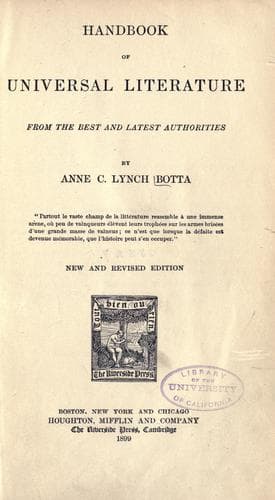
Handbook of Universal Literature, From the Best and Latest AuthoritiesBotta, Anne C. Lynch (Anne Charlotte Lynch)
History
Handbook of Universal Literature, From the Best and Latest Authorities
Botta, Anne C. Lynch (Anne Charlotte Lynch)
Literature -- History and criticism
The versatility of talent displayed by Cato the censor (224-144 B.C.)
entitles him to a place among orators, jurists, economists, and
historians. His life extends over a wide and important period of literary
history, when everything was in a state of change,--morals, social habits,
and literary taste. Cato was born in Tusculum, and passed his boyhood in
the pursuits of rural life at a small Sabine farm belonging to his father.
The skill with which he pleaded the causes of his clients before the rural
magistracy made his abilities known, and he rose rapidly to eminence as a
pleader. He filled many high offices of state. His energies were not
weakened by advancing age, and he was always ready as the advocate of
virtue, the champion of the oppressed, and the punisher of vice. With many
defects, Cato was morally and intellectually one of the greatest men Rome
ever produced. He had the ability and the determination to excel in
everything which he undertook. His style is rude, unpolished, ungraceful,
because to him polish was superficial, and, therefore, unreal. His
statements, however, were clear, his illustrations striking; the words
with which he enriched his native tongue were full of meaning; his wit was
keen and lively, and his arguments went straight to the intellect, and
carried conviction with them.
Cato's great historical and antiquarian work, "The Origins," was a history
of Italy and Rome from the earliest times to the latest events which
occurred in his own lifetime. It was a work of great research and
originality, but only brief fragments of it remain. In the "De Re
Rustica," which has come down to us in form and substance as it was
written, Cato maintains, in the introduction, the superiority of
agriculture over other modes of gaining a livelihood. The work itself is a
commonplace book of agriculture and domestic economy; its object is
utility, not science: it serves the purpose of a farmer's and gardener's
manual, a domestic medicine, herbal, and cookery book. Cato teaches his
readers, for example, how to plant osier beds, to cultivate vegetables, to
preserve the health of cattle, to pickle pork, and to make savory dishes.
Of the "Orations" of Cato, ninety titles are extant, together with
numerous fragments. In style he despised art. He was too fearless and
upright, too confident in the justness of his cause to be a rhetorician;
he imitated no one, and no one was ever able to imitate him. Niebuhr
pronounces him to be the only great man in his generation, and one of the
greatest and most honorable characters in Roman history.
Varro (116-28 B.C.) was an agriculturist, a grammarian, a critic, a
theologian, a historian, a philosopher, a satirist. Of his miscellaneous
works considerable portions are extant, sufficient to display his
erudition and acuteness, yet, in themselves, more curious than attractive.
Public-domain text, read in full here on John Shaqi.
Reviews
Reviews
No reviews yet
Be the first to share your thoughts on this work.
Elsewhere in the archive
Join the Discussion
Join the discussion
Sign in to leave a comment or review.
Sign InorCreate an account