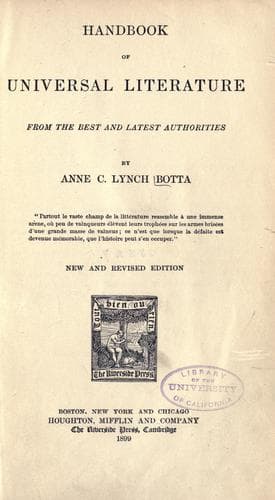
Handbook of Universal Literature, From the Best and Latest AuthoritiesBotta, Anne C. Lynch (Anne Charlotte Lynch)
History
Handbook of Universal Literature, From the Best and Latest Authorities
Botta, Anne C. Lynch (Anne Charlotte Lynch)
Literature -- History and criticism
Eloquence, though of a rude, unpolished kind, must have been, in the very
earliest times, a characteristic of the Roman people. It is a plant
indigenous to a free soil. As in modern times it has flourished especially
in England and America, fostered by the unfettered freedom of debate, so
it found a congenial home in free Greece and republican Rome. Oratory was,
in Rome, the unwritten literature of active life, and recommended itself
to a warlike and utilitarian people by its utility and its antagonistic
spirit. Long before the art of the historian was sufficiently advanced to
record a speech, the forum, the senate, the battlefield, and the threshold
of the jurisconsult had been nurseries of Roman eloquence, or schools in
which oratory attained a vigorous youth, and prepared for its subsequent
maturity.
While the legal and political constitution of the Roman people gave direct
encouragement to deliberative and judicial oratory, respect for the
illustrious dead furnished opportunities for panegyric. The song of the
bard in honor of the departed warrior gave place to the funeral oration.
Among the orators of this time were the two Scipios, and Galba, whom
Cicero praises as having been the first Roman who understood how to apply
the theoretical principles of Greek rhetoric.
All periods of political disquiet are necessarily favorable to eloquence,
and the era of the Gracchi was especially so. After a struggle of nearly
four centuries the old distinction of plebeian and patrician no longer
existed. Plebeians held high offices, and patricians, like the Gracchi,
stood forward as champions of popular rights. These stirring times
produced many celebrated orators. The Gracchi themselves were both
eloquent and possessed of those qualities and endowments which would
recommend their eloquence to their countrymen. Oratory began now to be
studied more as an art, and the interval between the Gracchi and Cicero
boasted of many distinguished names; the most illustrious among them are
M. Antonius, Crassus, and Cicero's contemporary and most formidable rival,
Hortensius.
M. Antonius (fl. 119 B.C.) entered public life as a pleader, and thus laid
the foundation of his brilliant career; but he was through life greater as
a judicial than as a deliberative orator. He was indefatigable in
preparing his case, and made every point tell. He was a great master of
the pathetic, and knew the way to the heart. Although he did not himself
give his speeches to posterity, some of his most pointed expressions and
favorite passages left an indelible impression on the memories of his
hearers, and many of them were preserved by Cicero. In the prime of life
he fell a victim to political fury, and his bleeding head was placed upon
the rostrum, which was so frequently the scene of his eloquent triumphs.
Public-domain text, read in full here on John Shaqi.
Reviews
Reviews
No reviews yet
Be the first to share your thoughts on this work.
Elsewhere in the archive
Join the Discussion
Join the discussion
Sign in to leave a comment or review.
Sign InorCreate an account