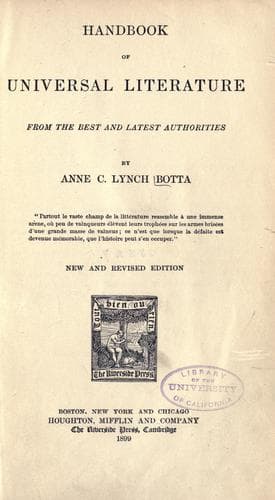
Handbook of Universal Literature, From the Best and Latest AuthoritiesBotta, Anne C. Lynch (Anne Charlotte Lynch)
History
Handbook of Universal Literature, From the Best and Latest Authorities
Botta, Anne C. Lynch (Anne Charlotte Lynch)
Literature -- History and criticism
The Roman pantomime differed somewhat from the mime. It was a ballet of
action, performed by a single dancer, who not only exhibited the human
figure in its most graceful attitudes, but represented every passion and
emotion with such truth that the spectators could, without difficulty,
understand the story. The pantomime was licentious in its character, and
the actors were forbidden by Tiberius to hold any intercourse with Romans
of equestrian or senatorial dignity.
These were the exhibitions which threw such discredit on the stage, which
called forth the well-deserved attacks of the early Christian fathers, and
caused them to declare that whoever attended them was unworthy of the name
of Christian. Had the drama not been so abused, had it retained its
original purity, and carried out the object attributed to it by Aristotle,
they would have seen it, not a nursery of vice, but a school of virtue;
not only an innocent amusement, but a powerful engine to form the taste,
to improve the morals, and to purify the feelings of a people.
3. EPIC POETRY.--The epic poets of this period selected their subjects
either from the heroic age and the mythology of Greece, or from their own
national history. The Augustan age abounds in representatives of these two
poetical schools, though possessing little merit. But the Romans,
essentially practical and positive in their character, felt little
interest in the descriptions of manners and events remote from their
associations, and poetry, restrained within the limits of their history,
could not rise to that height of imagination demanded by the epic muse.
Virgil united the two forms by selecting his subject from the national
history, and adorning the ancient traditions of Rome with the splendor of
Greek imagination.
Virgil (70-19 B.C.) was born at Andes, near Mantua; he was educated at
Cremona and at Naples, where he studied Greek literature and philosophy.
After this he came to Rome, where, through Maecenas, he became known to
Octavius, and basked in the sunshine of court favor. His favorite
residence was Naples. On his return from Athens, in company with Augustus,
he was seized with an illness of which he died. He was buried about a mile
from Naples, on the road to Pozzuoli; and a tomb is still pointed out to
the traveler which is said to be that of the poet. Virgil was deservedly
popular both as a poet and as a man. The emperor esteemed him and people
respected him; he was constitutionally pensive and melancholy, temperate,
and pure-minded in a profligate age, and his popularity never spoiled his
simplicity and modesty. In his last moments he was anxious to burn the
whole manuscript of the Aeneid, and directed his executors either to
improve it or commit it to the flames.
Public-domain text, read in full here on John Shaqi.
Reviews
Reviews
No reviews yet
Be the first to share your thoughts on this work.
Elsewhere in the archive
Join the Discussion
Join the discussion
Sign in to leave a comment or review.
Sign InorCreate an account