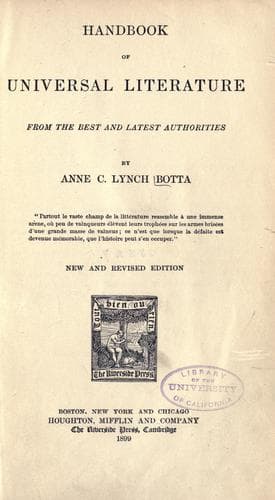
Handbook of Universal Literature, From the Best and Latest AuthoritiesBotta, Anne C. Lynch (Anne Charlotte Lynch)
History
Handbook of Universal Literature, From the Best and Latest Authorities
Botta, Anne C. Lynch (Anne Charlotte Lynch)
Literature -- History and criticism
2. MIMES, MIMOGRAPHERS, AND PANTOMIME.--Amidst all the splendor of the
Latin literature of this period, dramatic poetry never recovered from the
trance into which it had fallen, though the stage had not altogether lost
its popularity. Aesopus and Roscius, the former the great tragic actor,
and the latter the favorite comedian, in the time of Cicero, enjoyed his
friendship and that of other great men, and both amassed large fortunes.
But although the standard Roman plays were constantly represented,
dramatic literature had become extinct. The entertainments, which had now
taken the place of comedy and tragedy, were termed _mimes_. These were
laughable imitations of manners and persons, combining the features of
comedy and farce, for comedy represents the characters of a class, farce
those of individuals. Their essence was that of the modern pantomime, and
their coarseness, and even indecency, gratified the love of broad humor
which characterized the Roman people. After a time, when they became
established as popular favorites, the dialogue occupied a more prominent
position, and was written in verse, like that of tragedy and comedy.
During the dictatorship of Caesar, a Roman knight named Laberius (107-45
B.C.) became famous for his mimes. The profession of an actor of mimes was
infamous, but Laberius was a writer, not an actor. On one occasion, Caesar
offered him a large sum of money to enter the lists in a trial of his
improvisatorial skill. Laberius did not submit to the degradation for the
sake of the money, but he was afraid to refuse. The only method of
retaliation in his power was sarcasm. His part was that of a slave; and
when his master scourged him, he exclaimed: "Porro, Quirites, libertatem
perdimus!" His words were received with a round of applause, and all eyes
were fixed on Caesar. The dictator restored him to the rank of which his
act had deprived him, but he could never recover the respect of his
countrymen. As he passed the orchestra, on his way to the stalls of the
knights, Cicero cried out: "If we were not so crowded, I would make room
for you here." Laberius replied, alluding to Cicero's lukewarmness as a
political partisan: "I am astonished that you should be crowded, as you
generally sit on two stools."
Another writer and actor of mimes was Publius Syrus, originally a Syrian
slave. Tradition has recorded a _bon mot_ of his which is as witty as it
is severe. Seeing an ill-tempered man named Mucius in low spirits, he
exclaimed: "Either some ill fortune has happened to Mucius, or some good
fortune to one of his friends!"
Public-domain text, read in full here on John Shaqi.
Reviews
Reviews
No reviews yet
Be the first to share your thoughts on this work.
Elsewhere in the archive
Join the Discussion
Join the discussion
Sign in to leave a comment or review.
Sign InorCreate an account