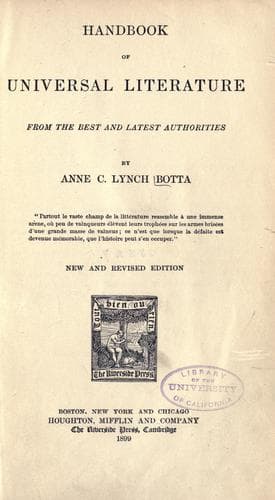
Handbook of Universal Literature, From the Best and Latest AuthoritiesBotta, Anne C. Lynch (Anne Charlotte Lynch)
History
Handbook of Universal Literature, From the Best and Latest Authorities
Botta, Anne C. Lynch (Anne Charlotte Lynch)
Literature -- History and criticism
4. DIDACTIC POETRY.--The poems, which first established the reputation of
Virgil as a poet, belong to didactic poetry. They are his Bucolics and
Georgics. The Bucolics are pastoral idyls; the characters are Italian in
all their sentiments and feelings, acting, however, the unreal and assumed
part of Greek shepherds. The Italians never possessed the elements of
pastoral life, and could not furnish the poet with originals and models
from which to draw his portraits. When represented as Virgil represents
them in his Bucolics, they are in masquerade, and the drama in which they
form the characters is of an allegorical kind. Even the scenery is
Sicilian, and does not truthfully describe the tame neighborhood of
Mantua. In fact, these poems are imitations of Theocritus; but, divesting
ourselves of the idea of the outward form which the poet has chosen to
adopt, we are touched by the simple narrative of disappointed loves and
childlike woes; we appreciate the delicately-veiled compliments paid by
the poet to his patron; we enjoy the inventive genius and poetical power
which they display, and we are elevated by the exalted sentiments which
they sometimes breathe.
The Georgics are poems on the labors and enjoyments of rural life, a
subject for which Rome offered a favorable field. Though in this style
Hesiod was the model of Virgil, his system is perfectly Italian, so much
so, that many of his rules may be traced in modern Italian husbandry, just
as the descriptions of implements in the Greek poet are frequently found
to agree with those in use in modern Greece. The great merit of the
Georgics consists in their varied digressions, interesting episodes, and
in the sublime bursts of descriptive vigor which are interspersed
throughout them. They have frequently been taken as models for imitation
by the didactic poets of all nations, and more particularly of England.
The "Seasons," for instance, is a thoroughly Virgilian poem.
Lucretius (95-51 B.C.) belongs to the class of didactic poets. He might
claim a place among philosophers as well as poets, for his poem marks an
epoch both in poetry and philosophy. But his philosophy is a mere
reflection from that of Greece, while his poetry is bright with the rays
of original genius. His poem on "The Nature of Things" is in imitation of
that of Empedocles. Its subject is philosophical and its purpose didactic;
but its unity of design gives to it almost the rank of an epic. Its
structure prevents it from being a complete and systematic survey of the
whole Epicurean philosophy, but as far as the form of the poem permitted,
it presents an accurate view of the philosophy which then enjoyed the
highest popularity.
Public-domain text, read in full here on John Shaqi.
Reviews
Reviews
No reviews yet
Be the first to share your thoughts on this work.
Elsewhere in the archive
Join the Discussion
Join the discussion
Sign in to leave a comment or review.
Sign InorCreate an account