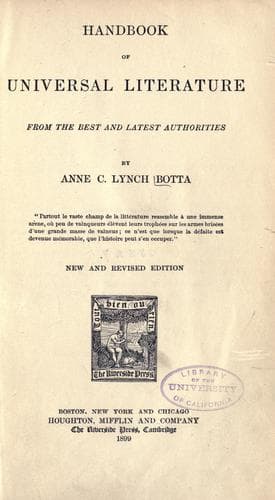
Handbook of Universal Literature, From the Best and Latest AuthoritiesBotta, Anne C. Lynch (Anne Charlotte Lynch)
History
Handbook of Universal Literature, From the Best and Latest Authorities
Botta, Anne C. Lynch (Anne Charlotte Lynch)
Literature -- History and criticism
The object of the poem of Lucretius is to emancipate mankind from the
debasing effects of superstition by an exposition of philosophy, and
though a follower of Epicurus, he is not entirely destitute of the
religious sentiment, for he deifies nature and has a veneration for her
laws. His infidelity must be viewed rather in the light of a philosophical
protest against the results of heathen superstition, than a total
rejection of the principles of religious faith.
Lucretius valued the capabilities of the Latin language. He wielded at
will its power of embodying the noblest thoughts, and showed how its
copious and flexible properties could overcome the hard technicalities of
science. The great beauty of his poetry is its variety; his fancy is
always lively, his imagination has always free scope. He is sublime, as a
philosopher who penetrates the secrets of the natural world, and discloses
to the eyes of man the hidden causes of its wonderful phenomena. His
object was a lofty one; for although the absurdities of the national creed
drove him into skepticism, his aim was to set the intellect free from the
trammels of superstition. But besides grandeur and sublimity, we find the
totally different qualities of softness and tenderness. Rome had long
known nothing but war, and was now rent by civil dissension. Lucretius
yearned for peace; and his prayer, that the fabled goddess of all that is
beautiful in nature would heal the wounds which discord had made, is
distinguished by tenderness and pathos even more than by sublimity. He is
superior to Ovid in force, though inferior in facility; not so smooth or
harmonious as Virgil, his poetry always falls upon the ear with a swelling
and sonorous melody. Virgil appreciated his excellence, and imitated not
only single expressions, but almost entire verses and passages; and Ovid
exclaims, that the sublime strains of Lucretius shall never perish until
the world shall be given up to destruction.
Public-domain text, read in full here on John Shaqi.
Reviews
Reviews
No reviews yet
Be the first to share your thoughts on this work.
Elsewhere in the archive
Join the Discussion
Join the discussion
Sign in to leave a comment or review.
Sign InorCreate an account