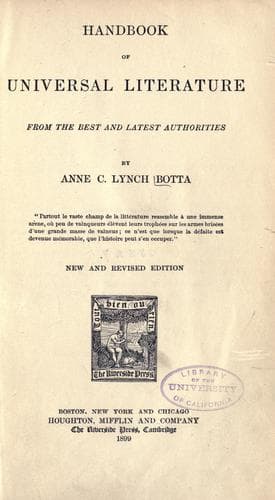
Handbook of Universal Literature, From the Best and Latest AuthoritiesBotta, Anne C. Lynch (Anne Charlotte Lynch)
History
Handbook of Universal Literature, From the Best and Latest Authorities
Botta, Anne C. Lynch (Anne Charlotte Lynch)
Literature -- History and criticism
5. LYRIC POETRY.--The Romans had not the ideality and the enthusiasm which
are the elements of lyric poetry, and in all the range of their literature
there are only two poets who, greatly inferior to the lyric poets of
Greece, have a positive claim to a place in this department, Catullus and
Horace. Catullus (86-46 B.C.) was born near Verona. At an early age he
went to Rome, where he plunged into all the excesses of the capital, and
where his sole occupation was the cultivation of his literary tastes and
talents. A career of extravagance and debauchery terminated in the ruin of
his fortune, and he died at the age of forty. The works of Catullus
consist of numerous short pieces of a lyrical character, elegies and other
poems. He was one of the most popular of the Roman poets, because he
possessed those qualities which the literary society at Rome most valued,
polish and learning, and because, although an imitator, there was a truly
Roman nationality in all that he wrote. His satire was the bitter
resentment of a vindictive spirit; his love and his hate were both purely
selfish, but his excellences were of the most alluring and captivating
kind. He has never been surpassed in gracefulness, melody, and tenderness.
Horace (65-8 B.C.), like Virgil and other poets of his time, enjoyed the
friendship and intimacy of Maecenas, who procured for him the public grant
of his Sabine farm, situated about fifteen miles from Tivoli. At Rome he
occupied a house on the beautiful heights of the Esquiline. The rapid
alternation of town and country life, which the fickle poet indulged in,
gives a peculiar charm to his poetry. His "Satires" were followed by the
publication of the "Odes" and the "Epistles." The satires of Horace
occupied the position of the fashionable novel of our day. In them is
sketched boldly, but good-humoredly, a picture of Roman social life, with
its vices and follies. They have nothing of the bitterness of Lucilius,
the love of purity and honor that adorns Persius, or the burning
indignation of Juvenal at the loathsome corruption of morals. Vice, in his
day, had not reached that appalling height which it attained in the time
of the emperors who succeeded Augustus. Deficient in moral purity, nothing
would strike him as deserving censure, except such excess as would
actually defeat the object which he proposed to himself, namely, the
utmost enjoyment of life. In the "Epistles," he lays aside the character
of a moral teacher or censor, and writes with the freedom with which he
would converse with an intimate friend. But it is in his inimitable "Odes"
that the genius of Horace as a poet is especially displayed; they have
never been equaled in beauty of sentiment, gracefulness of language, and
melody of versification; they comprehend every variety of subject suitable
to the lyric muse; they rise without effort to the most elevated topics;
and they descend to the simplest joys and sorrows of every-day life.
Public-domain text, read in full here on John Shaqi.
Reviews
Reviews
No reviews yet
Be the first to share your thoughts on this work.
Elsewhere in the archive
Join the Discussion
Join the discussion
Sign in to leave a comment or review.
Sign InorCreate an account