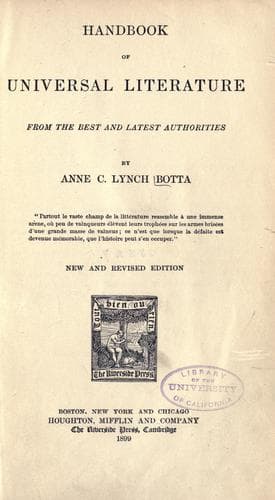
Handbook of Universal Literature, From the Best and Latest AuthoritiesBotta, Anne C. Lynch (Anne Charlotte Lynch)
History
Handbook of Universal Literature, From the Best and Latest Authorities
Botta, Anne C. Lynch (Anne Charlotte Lynch)
Literature -- History and criticism
Ovid (43 B.C.-6 A.D.), the most fertile of the Latin poets, not only in
elegy, but also in other kinds of poetry, was enabled by his rank,
fortune, and talents to cultivate the society of men of congenial tastes.
A skeptic and an epicurean, he lived a life of continual indulgence and
intrigue. He was a universal admirer of the female sex, and a favorite
among women. He was popular as a poet, successful in society, and
possessed all the enjoyments that wealth could bestow; but later in life
he incurred the anger of Augustus, and was banished to the very frontier
of the Roman empire, where he lingered for a few years and died in great
misery. The "Epistles to and from Women of the Heroic Age" are a series of
love-letters; with the exception of the "Metamorphoses," they have been
greater favorites than any other of his works. Love, in the days of Ovid,
had in it nothing pure or chivalrous. The age in which he lived was
morally polluted, and he was neither better nor worse than his
contemporaries; hence grossness is the characteristic of his "Art of
Love." His "Metamorphoses" contain a series of mythological narratives
from the earliest times to the translation of the soul of Julius Caesar
from earth to heaven, and his metamorphosis into a star. In this poem
especially may be traced that study and learning by which the Roman poets
made all the treasures of Greek literature their own. "The Fasti," a poem
on the Roman calendar, is a beautiful specimen of simple narrative in
verse, and displays, more than any of his works, his power of telling a
story without the slightest effort, in poetry as well as prose. The five
books of the "Tristia," and the "Epistles from Pontus," were the
outpourings of his sorrowful heart during the gloomy evening of his days.
Public-domain text, read in full here on John Shaqi.
Reviews
Reviews
No reviews yet
Be the first to share your thoughts on this work.
Elsewhere in the archive
Join the Discussion
Join the discussion
Sign in to leave a comment or review.
Sign InorCreate an account