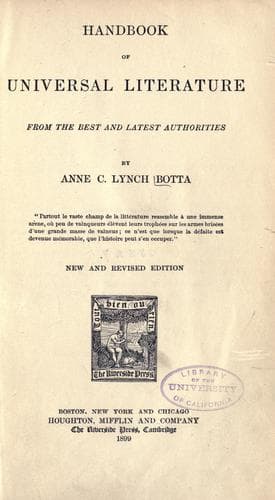
Handbook of Universal Literature, From the Best and Latest AuthoritiesBotta, Anne C. Lynch (Anne Charlotte Lynch)
History
Handbook of Universal Literature, From the Best and Latest Authorities
Botta, Anne C. Lynch (Anne Charlotte Lynch)
Literature -- History and criticism
7. ORATORY AND PHILOSOPHY.--As oratory gave to Latin prose-writing its
elegance and dignity, Cicero (106-43 B.C.) is not only the representative
of the flourishing period of the language, but also the instrumental cause
of its arriving at perfection. He gave a fixed character to the Latin
tongue; showed his countrymen what vigor it possessed, and of what
elegance and polish it was susceptible. The influence of Cicero on the
language and literature of his day was not only extensive, but permanent,
and it survived almost until the language was corrupted by barbarism.
After traveling in Greece and Asia, and holding a high office in Sicily,
he returned to Rome, resumed his forensic practice, and was made consul.
The conspiracy of Catiline was the great event of his consulship. The
prudence and tact with which he crushed this gained him the applause and
gratitude of his fellow-citizens, who hailed him as the father of his
country; but he was obliged, by the intrigues of his enemies, to fly from
Rome; his exile was decreed, and his town and country houses given up to
plunder. He was, however, recalled, and appointed to a seat in the college
of Augurs. In the struggle between Pompey and Caesar, he followed the
fortunes of the former; but Caesar, after his triumph, granted him a full
and free pardon. After the assassination of Caesar, Cicero delivered that
torrent of indignant and eloquent invective, his twelve Philippic
orations, and became again the popular idol; but when the second
triumvirate was formed, and each member gave up his friends to the
vengeance of his colleagues, Octavius did not hesitate to sacrifice
Cicero. Betrayed by a treacherous freedman, he would not permit his
attendants to make any resistance, but courageously submitted to the sword
of the assassins, who cut off his head and hands, and carried them to
Antony, whose wife, Julia, gloated with inhuman delight upon the pallid
features, and in petty spite pierced with a needle the once eloquent
tongue. Cicero had numerous faults; he was vain, vacillating, inconstant,
timid, and the victim of morbid sensibility; but he was candid, truthful,
just, generous, pure-minded, and warm-hearted. Gentle, sympathizing, and
affectionate, he lived as a patriot and died as a philosopher.
Public-domain text, read in full here on John Shaqi.
Reviews
Reviews
No reviews yet
Be the first to share your thoughts on this work.
Elsewhere in the archive
Join the Discussion
Join the discussion
Sign in to leave a comment or review.
Sign InorCreate an account