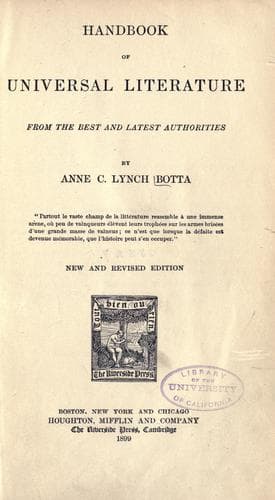
Handbook of Universal Literature, From the Best and Latest AuthoritiesBotta, Anne C. Lynch (Anne Charlotte Lynch)
History
Handbook of Universal Literature, From the Best and Latest Authorities
Botta, Anne C. Lynch (Anne Charlotte Lynch)
Literature -- History and criticism
His first work is on the "Jugurthine War;" the next related to the period
from the consulship of Lepidus to the praetorship of Cicero, and is
unfortunately lost. This was followed by a history of the conspiracy of
Catiline, "The War of Catiline," in which he paints in vivid colors the
depravity of that order of society which, bankrupt in fortune and honor,
still plumes itself on its rank and exclusiveness. To Sallust must be
conceded the praise of having first conceived the notion of a history, in
the true sense of the term. He was the first Roman historian, and the
guide of future historians. He had always an object to which he wished all
his facts to converge, and he brought them forward as illustrations and
developments of principles. He analyzed and exposed the motives of
parties, and laid bare the inner life of those great actors on the public
stage, in the interesting historical scenes which he describes. His style,
although ostentatiously elaborate and artificial, is, upon the whole,
pleasing, and almost always transparently clear. Following Thucydides,
whom he evidently took as his model, he strives to imitate his brevity;
but while this quality with the Greek historian is natural and
involuntary, with the Roman it is intentional and studied. The brevity of
Thucydides is the result of condensation, that of Salust is elliptical
expression.
Livy (59-18 B.C.) was born in Padua, and came to Rome during the reign of
Augustus, where he resided in the enjoyment of the imperial favor and
patronage. He was a warm and open admirer of the ancient institutions of
the country, and esteemed Pompey as one of its greatest heroes; but
Augustus did not allow political opinions to interfere with the regard
which he entertained for the historian. His great work is a history of
Rome, which he modestly terms "Annals," in one hundred and forty-two
books, of which thirty-five are extant. Besides his history, Livy is said
to have written treatises and dialogues, which were partly philosophical
and partly historical.
Public-domain text, read in full here on John Shaqi.
Reviews
Reviews
No reviews yet
Be the first to share your thoughts on this work.
Elsewhere in the archive
Join the Discussion
Join the discussion
Sign in to leave a comment or review.
Sign InorCreate an account