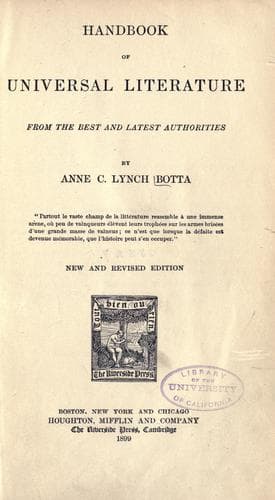
Handbook of Universal Literature, From the Best and Latest AuthoritiesBotta, Anne C. Lynch (Anne Charlotte Lynch)
History
Handbook of Universal Literature, From the Best and Latest Authorities
Botta, Anne C. Lynch (Anne Charlotte Lynch)
Literature -- History and criticism
The Commentaries of Caesar have been compared with the work of the great
soldier-historian of Greece, Xenophon. Both are eminently simple and
unaffected, but there the parallel ends. The severe contempt of ornament,
which characterizes the stern Roman, is totally unlike the mellifluous
sweetness of the Attic writer.
Sallust (85-35 B.C.) was born of a plebeian family, but, having filled the
offices of tribune and quaestor, attained senatorial rank. He was expelled
from the Senate for his profligacy, but restored again to his rank through
the influence of Caesar, whose party he espoused. He accompanied his
patron in the African war, and was made governor of Numidia. While in that
capacity, he accumulated by rapacity and extortion enormous wealth, which
he lavished in expensive but tasteful luxury. The gardens on the Quirinal
which bore his name were celebrated for their beauty; and there,
surrounded by the choicest works of art, he devoted his retirement to
composing the historical records which survived him. As a politician, he
was a mere partisan of Caesar, and therefore a strenuous opponent of the
higher classes and of the supporters of Pompey. The object of his hatred
was not the old patrician blood of Rome, but the new aristocracy, which
had of late years been rapidly rising up and displacing it. That new
nobility was utterly corrupt, and its corruption was encouraged by the
venality of the masses, whose poverty and destitution tempted them to be
the tools of unscrupulous ambition. Sallust strove to place that party in
the unfavorable light which it deserved; but, notwithstanding the
truthfulness of the picture which he draws, selfishness and not patriotism
was the mainspring of his politics; he was not an honest champion of
popular rights, but a vain and conceited man, who lived in an immoral and
corrupt age, and had not the strength of principle to resist the force of
example and temptation. If, however, we make some allowance for the
political bias of Sallust, his histories have not only the charms of the
historical romance, but are also valuable political studies. His
characters are vigorously and naturally drawn, and the more his histories
are read, the more obvious it is that he always writes with an object, and
uses his facts as the means of enforcing a great political lesson.
Public-domain text, read in full here on John Shaqi.
Reviews
Reviews
No reviews yet
Be the first to share your thoughts on this work.
Elsewhere in the archive
Join the Discussion
Join the discussion
Sign in to leave a comment or review.
Sign InorCreate an account