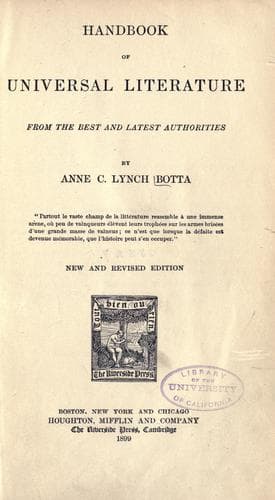
Handbook of Universal Literature, From the Best and Latest AuthoritiesBotta, Anne C. Lynch (Anne Charlotte Lynch)
History
Handbook of Universal Literature, From the Best and Latest Authorities
Botta, Anne C. Lynch (Anne Charlotte Lynch)
Literature -- History and criticism
Juvenal flourished in the reign of Domitian, towards the close of the
first century A.D., a dark period, which saw the utter moral degradation
of the people, and the bloodiest tyranny and oppression on the part of
their rulers. The picture of Roman manners, as painted by his glowing
pencil, is truly appalling. The fabric of society was in ruins, the
popular religion was rejected with scorn, and the creed of natural
religion had not occupied its place. The emperors took part in public
scenes of folly and profligacy, and exposed themselves as charioteers, as
dancers, and as actors. Nothing was respected but wealth, nothing provoked
contempt but poverty. Players and dancers had all honors and offices at
their disposal; the city swarmed with informers, who made the rich their
prey; every man feared his most intimate friend, and the only bond of
friendship was to be an accomplice in crime. The teacher would corrupt his
pupil, and the guardian defraud his ward. Crimes which cannot be named
were common, and the streets of Rome were the constant scene of robbery,
assault, and assassination. The morals of women were as depraved as those
of men, and there was no public amusement so immoral or so cruel as not to
be countenanced by their presence. In this period of moral dearth, the
fountains of genius and literature were dried up. There was criticism,
declamation, panegyric, and verse writing, but no oratory, history, or
poetry. Juvenal, though himself not free from the declamatory affectation
of the day, attacked the false literary taste of his contemporaries as
unsparingly as he did their depraved morality. His sixteen satires exhibit
an enlightened, truthful, and comprehensive view of Roman manners, and of
the inevitable result of such depravity. The two finest of them are those
which Dr. Johnson has thought worthy of imitation.
The historical value of these satires must not be forgotten. Tacitus lived
in the same perilous times as Juvenal, and when they had come to an end
and it was not unsafe to speak, he wrote their public history, which the
poet illustrates by displaying the social and inner life of the Romans.
Their works are parallel, and each forms a commentary upon the other. The
style of Juvenal is vigorous and lucid; his morals were pure in the midst
of a debased age, and his language shines forth in classic elegance, in
the midst of specimens of declining and degenerate taste.
Juvenal closes the list of Roman satirists, properly speaking. The
satirical spirit animates the piquant epigrams of his friend Martial, but
their purpose is not moral or didactic. They sting the individual, and
render him an object of scorn and disgust, but they do not hold up vice
itself to ridicule and detestation.
Public-domain text, read in full here on John Shaqi.
Reviews
Reviews
No reviews yet
Be the first to share your thoughts on this work.
Elsewhere in the archive
Join the Discussion
Join the discussion
Sign in to leave a comment or review.
Sign InorCreate an account